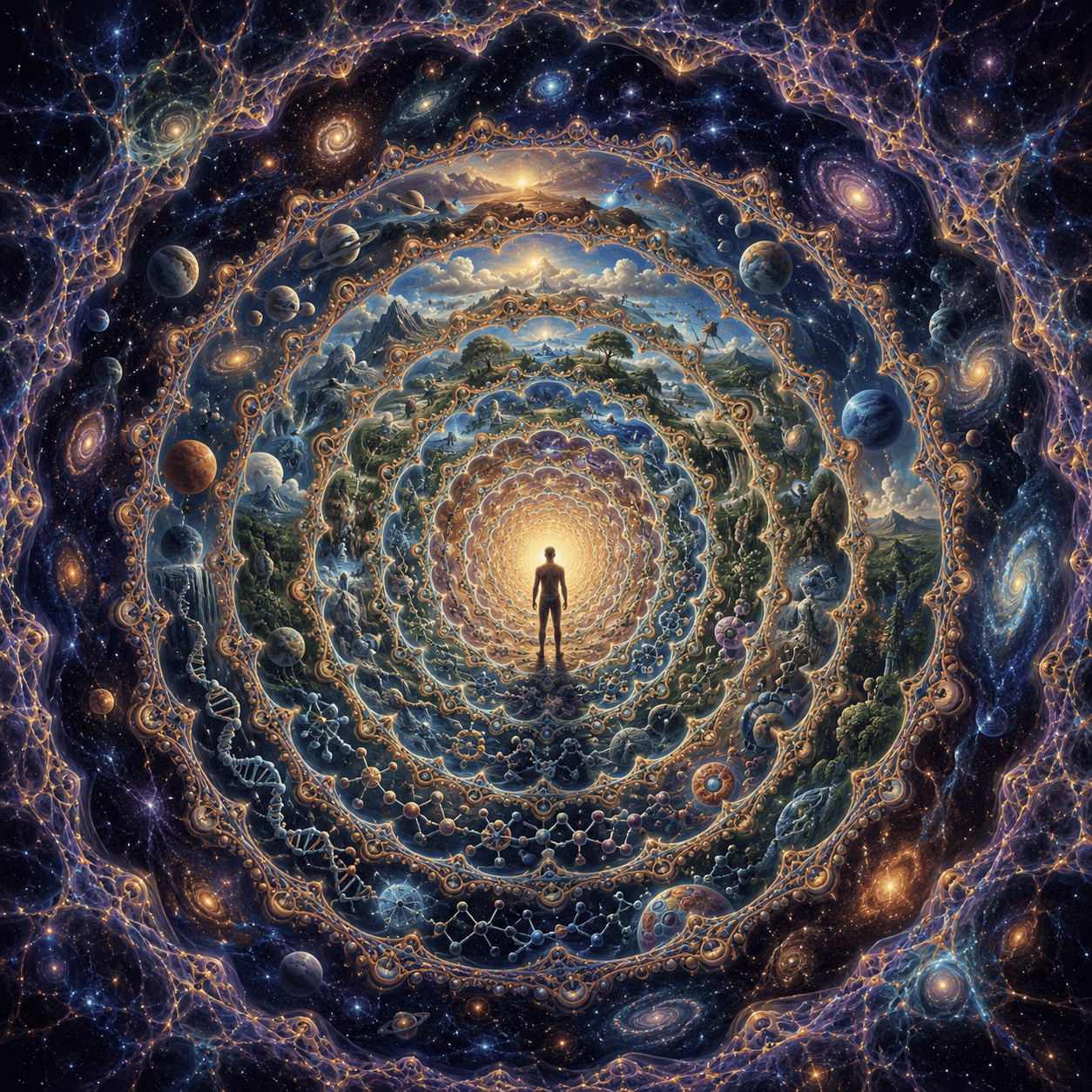
Look closely at a tree. Each branch carries the shape of the whole, and each twig carries it again. Zoom into a coastline and the same jagged pattern appears at every scale. Watch lightning fork across the sky and it looks like a tree. Look at a bare tree against the sky and it looks like lightning.
This is fractality: self-similar patterns repeating at every scale of reality. It isn’t a mathematical curiosity. It’s a structural feature of the world we live in.
But why?
The Source Code
If the world is fractal, something is repeating through it. Every fractal has a generating principle, the rule that produces the pattern at every scale. The Mandelbrot set looks infinitely complex, but it all comes from one simple equation run over and over.
The Christian claim is that reality has a generating principle too. In the beginning was the Word. The Greek is logos, and it carries far more than speech: reason, ratio, the logic a thing runs on, the very root of our word “logic.” That is why the Word can be the organizing principle through which all things were made and in which all things hold together, not merely something spoken but the structure reality itself is built on.
Grant that the Logos is that principle. A structure, though, does not have to make anything, so the question is a real one: why would such a source generate anything at all, let alone a pattern that keeps repeating itself? The answer the Christian tradition gives is that the source is love, and love does not stay still. Pseudo-Dionysius said it plainly in the fifth century: love cannot remain shut up in itself, it overflows. Richard of St. Victor, seven centuries later, saw why. Love turned in on itself stops being love at all. It is a gift, and a gift needs a real other to receive it. So the overflow isn’t an accident or an afterthought. It is built in.
Within God, the Father’s love goes out to the Son, and the delight they share is so full it spills over into a third, the way a couple’s love spills over into a child. Creation is the next overflow, love so abundant it spills past even that first relationship, and every creature is a finite drop of the excess.
This is why the pattern propagates. The fractal repeats because love repeats, and love repeats because it is relational all the way down. It cannot close in on itself without ceasing to be love at all.
If that holds, then whatever repeats through the fractal carries the signature of its source. A child carries the face of its parent; what is made carries the mark of its maker. So a world made through the Logos should carry the likeness of the Logos. And the signature that turns up most consistently is trinitarian, appearing across domains that have no business resembling one another, in ways that are hard to explain if the world is only matter. It isn’t the only shape fractality produces, but its reach is worth taking seriously.
The Line, the Circle, and the Triangle
The line is the masculine principle, order, direction, structure. Think of the male body: erect, angular, reaching upward. Buildings, skylines, roads cutting through landscape — civilization itself reflects this impulse. The line imposes form on the world. Without it, nothing is built and nothing holds. But taken too far, order becomes rigidity. Life is squeezed out. What cannot be made efficient is eliminated.
The circle is the feminine principle, chaos in the fullest sense of the word. Not the modern caricature of disorder, but chaos as formidable: the birthgiver of everything, order included. Think of the female body: curved, containing, rounded, generating life in its own cyclical way. Without it, nothing is born and nothing renews. But taken too far, chaos dissolves into flood. Form never coheres. What tries to rise is pulled back under.
The body shows each principle at its sharpest, but neither belongs to one sex. Every person is built from both.
A garden is what happens when they meet rightly. Chaotic plants, growing according to their own nature, set within ordered rows and bounded by walls. Neither principle dominating the other. Chaos given form without being killed by it; order given life without consuming what it organizes.
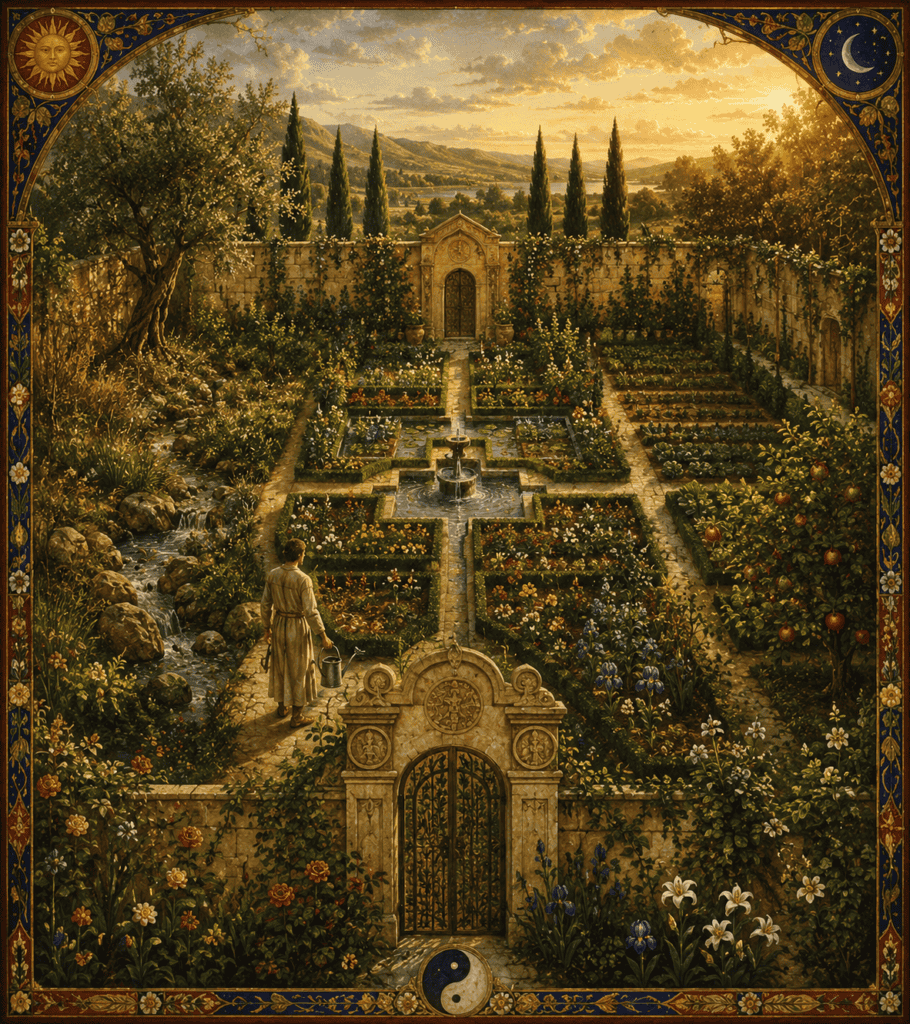
Pull them apart and each one turns deadly, in opposite directions. Too much order and nothing lives: it marches in lockstep, heels striking as one, grinding whatever breaks the pattern into the pavement — clean, uniform, a sterile tomb. Too much chaos and nothing holds: the wild breaches the walls, tears through the rows, and closes over everything in a grip that will not let go. The tyrant king and the devouring mother are the same failure from opposite ends. Each principle alone kills, and that is why their union is not decoration but necessity.
The garden is the oldest human image of right relationship between the two.
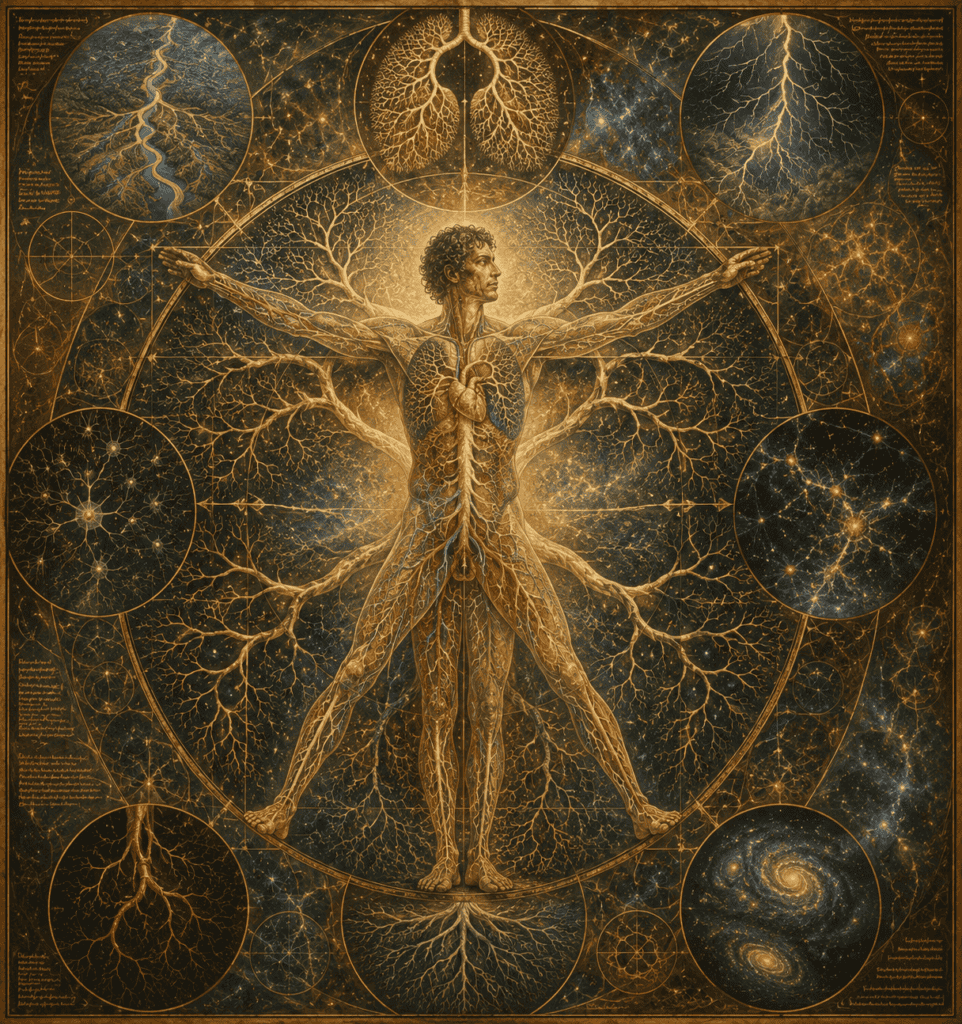
Da Vinci saw the same convergence in the human body. The Vitruvian Man, inscribed simultaneously in circle and square, wasn’t decorative. Every human form is the meeting point of both principles, held together in a single person.
But there is a more immediate instance still. Consider the physical act of speech itself. The mouth is the circle, curved, containing, open. The tongue is the line, directional, articulating, imposing form. In the union of these two distinct anatomical forms, something emerges that is neither of them alone: the word.
This is not a metaphor imposed on the body. It is the body’s own structure. The circle and the line meet in the human face, and what they produce is meaning elevated beyond either principle.
And they require a third thing: breath. You cannot speak without it. The ancient languages knew this (pneuma in Greek, ruach in Hebrew, the same word for breath and spirit). And not only the ancient ones: Finnish, my mother tongue and a language related to neither, has it too — henki. The word requires the breath moving through the articulating union of tongue and mouth. Source, spirit, articulating form — word.
John 1:1 — In the beginning was the Word.
The cosmological claim and the physiological mechanism are the same structure at different scales. The fractal thesis at its most intimate: not galaxies, not coastlines, not neural networks. Your own face forming the syllables you are reading right now.
The Trinitarian arithmetic was already in the anatomy.
Now consider the triangle.
Three is the geometric minimum to enclose space. You cannot create an enclosed area with fewer than three lines. The triangle is the natural resolution of line and circle meeting, the generative tension between the two principles resolving upward into a third point. It is not just synthesis but elevation. The base holds the tension; the apex is what that tension produces. In your own mouth: the circle and the line at the base, the word they make rising above them both.
This is why the trinitarian structure appears consistently across unrelated domains: length, width, depth; past, present, future; space, matter, time; Father, Son, Spirit. Three isn’t arbitrary. It’s the minimum required for the generative principle to complete itself.
The triangle doesn’t contain God. It points past itself.
A Word Is a Difference
The two principles meeting to make a third shows up in the body and in the world. It even shows up at the very bottom of things. Tap out a message in Morse that is all dots and no dashes, and you have said nothing at all. A page of pure white says nothing either; the letters only mean something because they break it. Meaning always needs difference. So a reality that was pure sameness, oneness with no edges, no inside and no outside, could not carry a single message. It could not say anything. It could not even be a word. In the beginning was the Word says that difference was there from the very start. Because a word is a difference.
And you are proving it right now. You could not read a single word of this if every letter were the same. Difference isn’t just back at the start. It is in your eyes this second, and you cannot even doubt it without using it.
I Am That I Am
When God names himself in Exodus, he does something strange. Every other name leans on something else. You are named for your father, your trade, the town you came from. God names himself after nothing at all. I am that I am. Sooner or later every child asks it: but who made God? The name is the answer. Everything else is a link in a chain, each link hanging from the one above it. He is the hook the whole chain hangs from, and the hook hangs on nothing.
There is more inside the name than English lets through. In the Hebrew, “I am” is not a settled statement. The verb is unfinished, open-ended, reaching forward: closer to “I will be what I will be” than to a closed declaration. Thomas Aquinas saw what this meant and called God not the ground of being but the act of being. Not a thing that exists, but existence itself in motion. A ground is something you stand on; it holds still while you move. An act is alive. It carries this moment forward into the next, the way a voice carries a word. He is not the platform under reality. He is the carrying.
This is why the fractal has no bottom and no top. You can look closer and closer forever and never hit a floor, because there is no floor under him to reach. You reach him, and he needs nothing beneath him to hold him up.
The Alpha and Omega holds both directions simultaneously. The innermost fractal deepens into the inner infinite. The outermost fractal opens into the outer infinite. Both directions point toward the same self-existing source, the one for whom there is no prior cause, because being itself is what he is.
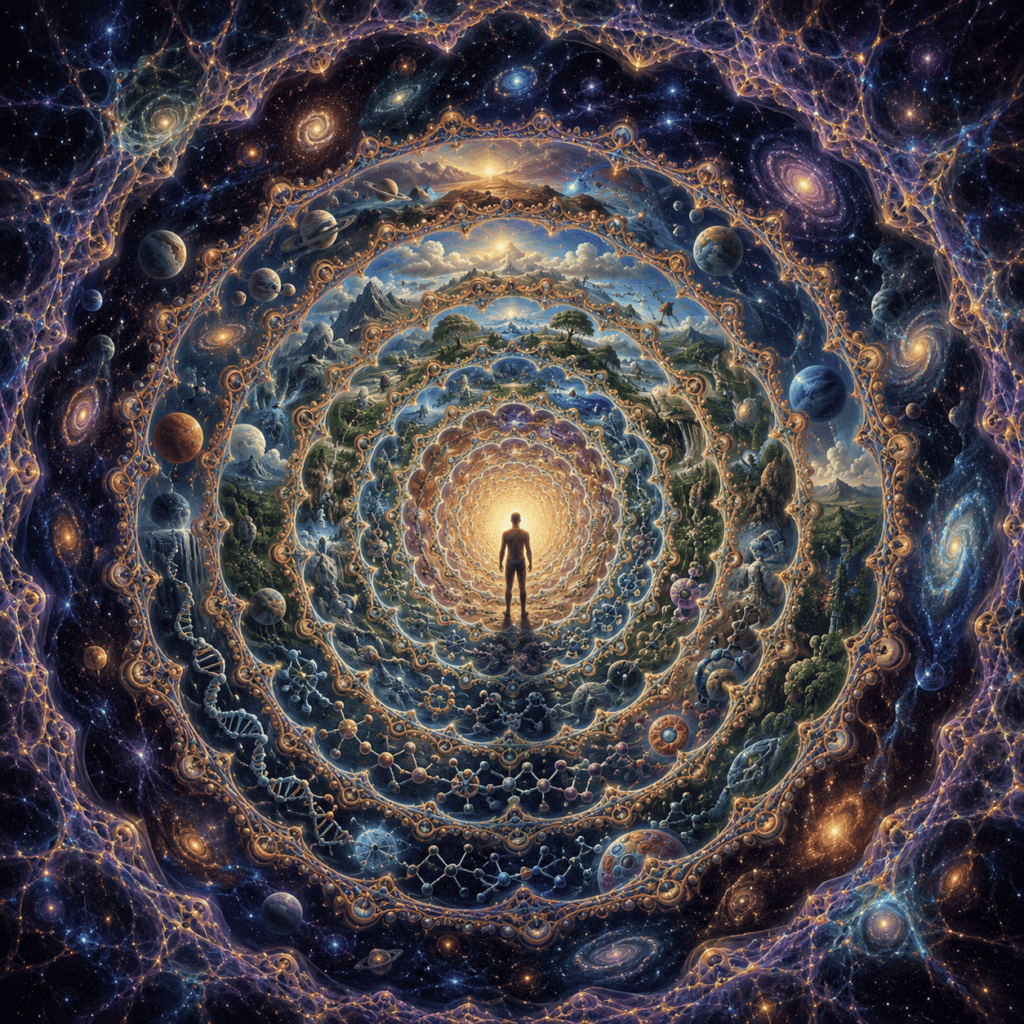
You are not standing outside the infinite, looking in. You are inside it, the way an app runs inside a phone and cannot step out to see it. And here is the one difference that changes everything: what you are inside is not a dead machine. He is alive. You will never reach the end of him, because he has none. In him we live and move and have our being.
The Mandala: The Same Circle, Drawn the World Over
The psychologist Carl Jung noticed something strange. All over the world, in cultures that had never met, people kept drawing the same shape, in their art, their dreams, their religious symbols. He called it the mandala: a circle built around a center, the same pattern spreading out from the middle. You have seen it without knowing the name: a spider’s web, the spokes of a wheel, the face of a clock, a halved orange.
Look at what the shape is made of. A round outside, which is the circle. Straight lines and figures inside it, putting the space in order, which is the line. It is the two principles again, the same two from the garden, drawn as a single picture. Not pure circle and not pure line, but both, held together.
The triangle is in there too. In Hindu sacred diagrams, two triangles interlock, one pointing up and one pointing down: the reach up toward the source, and the coming down into matter. Together they make the Star of David: both directions held at once, in one shape.
I won’t pretend a shape proves anything. But look at what it keeps showing: the same structure wherever these traditions looked, outward into the cosmos, inward into the mind, down into matter, up toward the source.
Every mandala is built around a center: a still point everything turns around. Jung called it the Self, a pattern of the mind, which is as far as a psychologist can go. But when the needle swings to the same point in everyone, it is pointing at something real. The center is not only in us; it is what we are all turning toward — the organizing principle of reality itself, the Logos. Jung found the shape, and he found the center. This is who was standing in it.
This was no new discovery. For a thousand years the Church drew the same mandala on purpose: Christ at the dead center, the four-cornered world turning around him — four winds, four seasons, the four rivers of Eden. The tradition had drawn the center, and given it a face, all along.
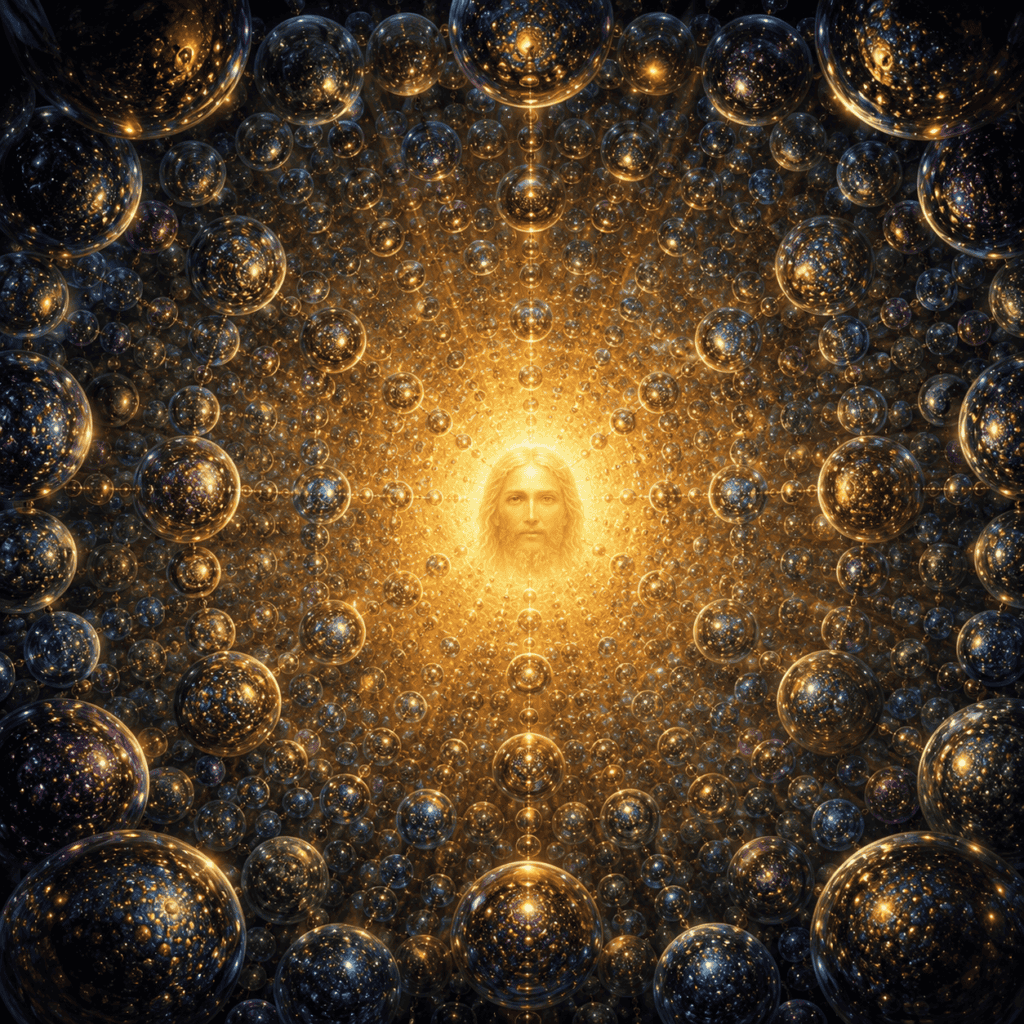
The pattern shows itself to anyone who looks carefully. The only question left is what you do with what you’re seeing.
The Pattern at Every Scale
Up to now we have seen the three standing still: drawn as a triangle, spoken as a word, built into the frame of the world. But the three does not only stand. It moves. Set it inside time and the same shape becomes a story: alive, then dead, then alive again, but never the same. What rises is never what went into the ground. Bury a seed and it does not come back as a seed; it breaks the soil open as a tree it could never have been until it died. That is the staggering law written underneath everything: death here is not the end of the story, it is the door. The grave is a womb.
Christianity makes a specific claim: that Christ’s death and resurrection is not merely a historical event but the hinge of reality itself. That’s an extraordinary claim. What makes it worth taking seriously is that the pattern it describes appears everywhere, at every scale, in every domain, whether or not anyone designed it to.
Seeds die in the ground before they become plants. A caterpillar dissolves into soup before it becomes a butterfly. Sleep is a small death before a return. Muscle tears before it grows back stronger. Psychologically, the false self has to die before genuine growth becomes possible. The self-justifying narrative has to break down before anything true can come through.
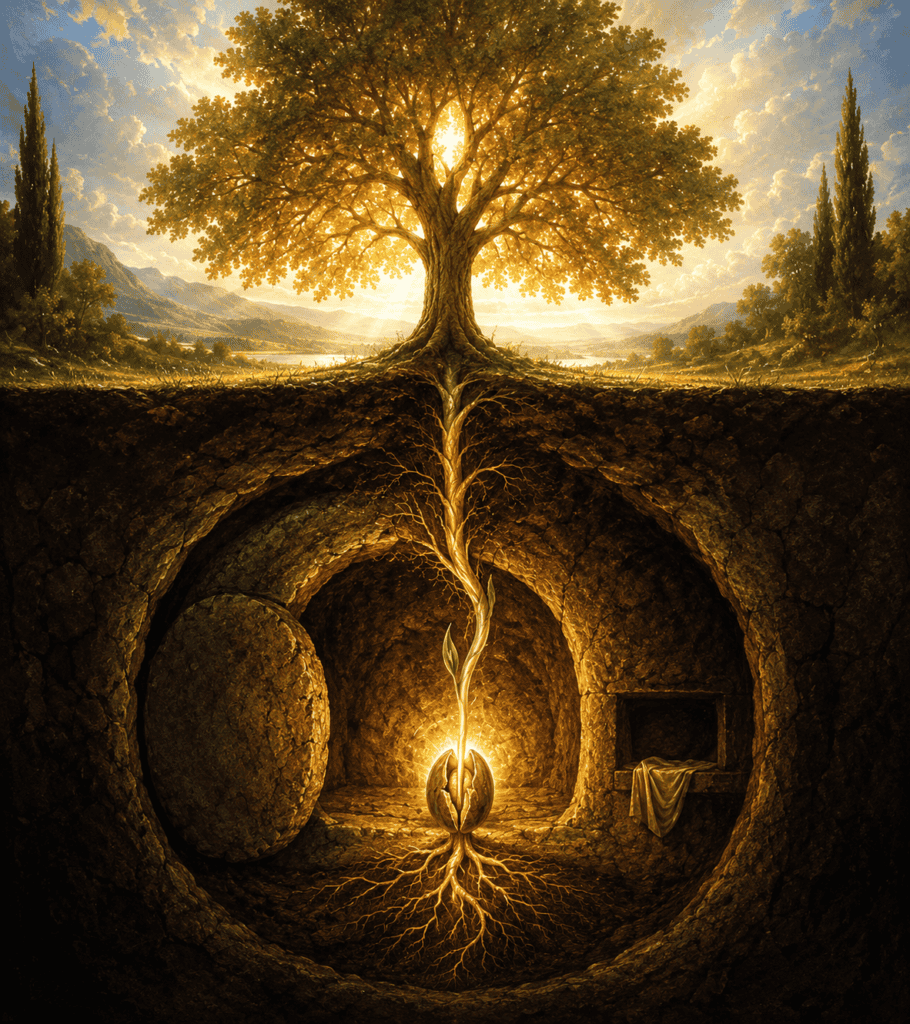
There is one scale you don’t have to take on trust, because you can run it yourself, and it is the smallest one there is: the space behind your own eyes. Go silent for five minutes. Most people can’t, and that failure is the first piece of evidence that something in us would rather stay busy than be fully known. Sit in it anyway, and the same shape you saw in the dying seed and the falling civilization begins to appear, but this time, in you. The story you tell to hold yourself together comes apart. The false center you built your life around, the one that was never God, goes down. And something truer takes its place: not you running your own life, but the One you were actually made around. “Be still, and know that I am God.” The pattern that built the cosmos is the pattern that remakes a single soul in the dark. It is the one part of all this you can test tonight, with your eyes closed.
This isn’t metaphor dressed up as theology. It’s one pattern showing up at every level of reality. Christ’s death and resurrection isn’t an isolated event, and it isn’t one more turn of the wheel. It is the act the whole pattern runs from, done once and completely, in actual history. The pattern was already written into creation because the one who entered history was also the one through whom creation was made.
The same mold, pressed at every scale.
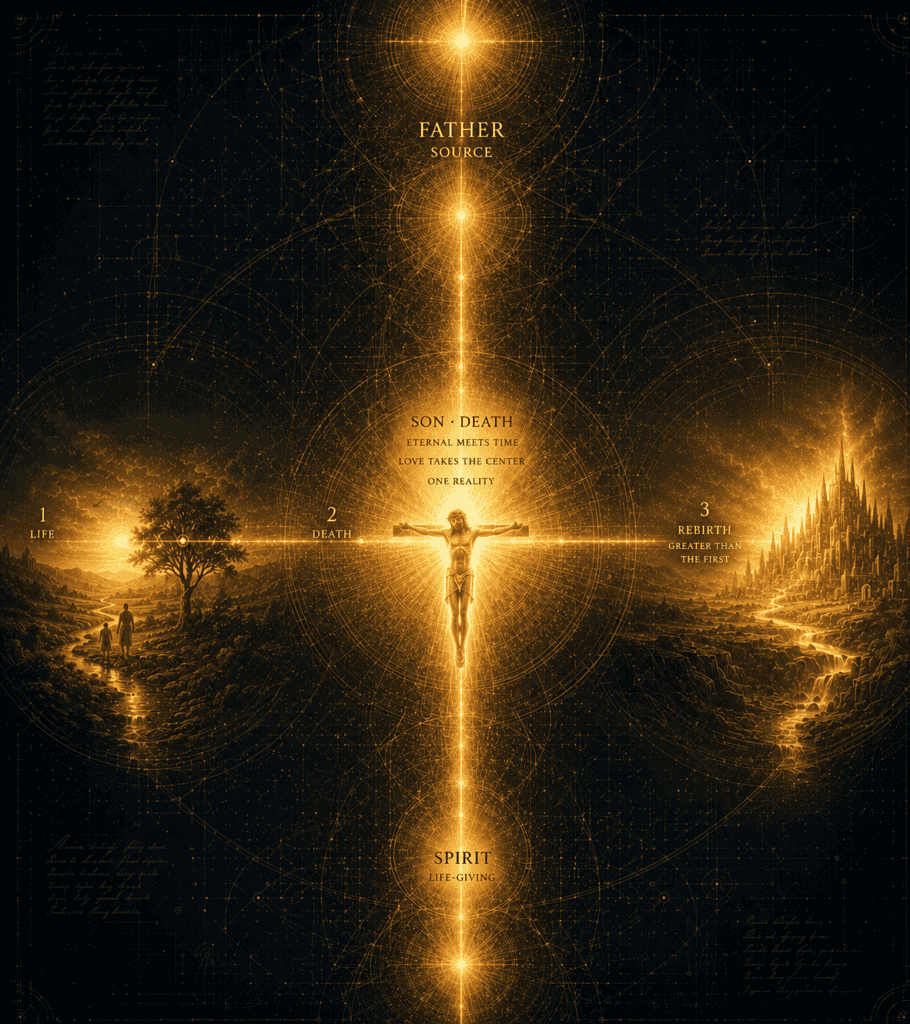
And the whole thing has a symbol, the most familiar one on earth: two lines crossing. But it is not two lines. It is two threes. One is the three that falls and rises: life, death, rebirth. The other is the three that stands: the eternal, the source, reaching down into the world. Now look at where they cross. The center of the moving three is death. The center of the eternal three is the Son. On the cross those two centers are the same point. The deathless Son stepped into the dead center of time, and because he did, the third beat, the rising, could lift the whole line up out of death with him. The most familiar object on earth is the floor plan of reality: the grave that is a womb, set exactly where the deathless meets death. And it is the mandala again, stood up off the page — the same center, its four directions now an upright beam and a crossbar. You have been reading about it the whole time.
Creation Returns
So what is the world, to the one who made it? It isn’t a separate thing running on its own, the way a clock keeps ticking after the maker leaves the room. And it isn’t something that melts back into God in the end, the way a wave flattens into the sea and is gone. It is stranger and better than both.
Think of a branch on a vine. It is really a branch, with its own shape and its own fruit. But the life moving through it was never its own. It is the vine’s life, borrowed every second, and cut off from the vine the branch doesn’t just struggle, it begins to die, because it had no life of its own to keep. That is what we are: real, distinct, genuinely ourselves, and alive only because life keeps flowing in from a source we did not make and cannot replace.
And the whole pattern has been driving at this. We have seen there is difference at the very bottom of things, that reality is never a blank, featureless oneness. Now we can say what that difference is, and it isn’t cold. At the bottom there is a Father, and a Son, and the love between them. The source was never a lonely One sitting by itself before the world began. It was always a relationship: love given and love returned, before there was anything else to love. Difference at the source turns out to mean love at the source. So we are not accidents thrown off by an indifferent machine. We are the overflow of a love that was already full. And that is why you do not have to vanish to come home. A Father does not want his child erased back into him like a drop into the ocean. He wants him home and still himself, finally whole. You become more yourself near the source, not less.
This also tells us what evil is, and what it isn’t. Evil isn’t a thing in its own right, a dark power squaring off against God. Darkness isn’t a substance; it is just the word for light gone missing. Evil is love bent crooked, reaching for the things God made instead of God, trying to squeeze unending life out of things too small to give it. It is the face turned away from the only place the light comes from. That does not make the harm any less real. It means the harm does not get the last word, because the light it lacks is the thing that lasts: the one who names himself I am that I am.
The world does not come back to God by disappearing into him. It comes back the way a branch comes into its own, by being fully and finally joined to the vine.
And do not mistake any of this for a soft thing. The love at the bottom of the world is the love of the Lord of Hosts, the God of armies, whose truth cuts like a blade and burns like fire. He is not fooled. He sees you exactly as you are. And here is the part that should stop you where you stand: he sees, and he loves you, right here and right now, and there is nothing you could even imagine doing that would turn his love away from you.
No One Comes to the Father Except Through Me
This is one of the lines people choke on. It sounds like a bouncer at the door, like Christianity pulling rank and deciding who gets in and who doesn’t. Read it that way and it’s offensive, and you can see why people are put off.
But read it through everything we have just seen and it stops being a rule and becomes a plain description of how things are. Remember who “me” is. The Son is the Logos, the pattern everything was made through and is held together by. So “no one comes to the Father except through me” isn’t a velvet rope. It is closer to saying you cannot enter the house except through the door, not because anyone is keeping you out, but because the door is the only way in. And the door is a real one: the Word, the one who took flesh, standing open onto the warm rooms behind him.
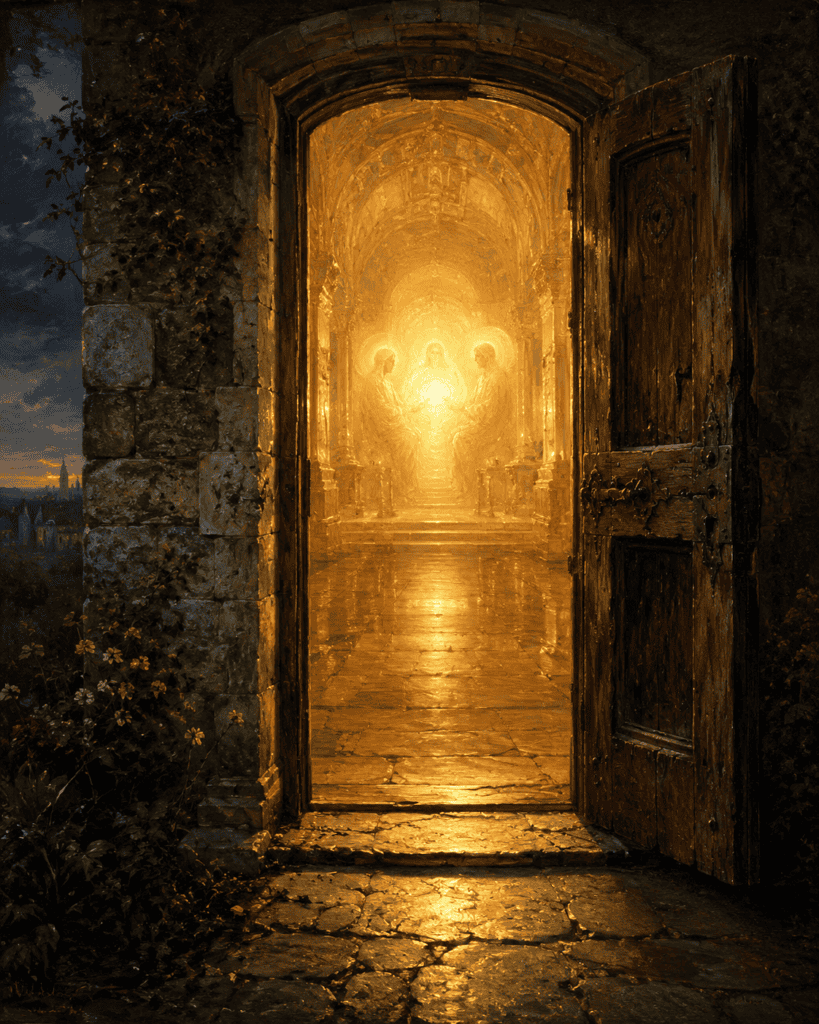
You cannot get to the source by stepping around the pattern that runs through everything, because that pattern is the door, and the door is the Son. It was never a rule about who is allowed in. It is just the architecture of the place.
This is why the trail we have followed does not end at a vague higher power or an impersonal force. It ends at someone. The whole pattern points to a source with a face, the one whose name is simply I am that I am. The Son was always the way to the Father, long before he was born in Bethlehem, because he is the pattern the whole world is built on. Before Abraham was, I am.
This is where the argument that began with a tree was always headed.
From Glory to Glory
Here is a strange and steadying fact about being human: you only ever see a part. Never the whole. And it holds in every direction you look. Look out at the universe and you see only as far as light has had time to reach you. Past that edge the world keeps going, the same pattern running on into a dark you cannot see. Look toward God and it is the same. Paul says we know in part, we see in part, not because we are slow, but because he has no edge to reach and you are a small thing standing inside something infinite. And look at your own life, the one you are living right now, and you see only the stretch you have already walked. You cannot see over the next rise. From inside a hard season you cannot see what it is making of you.
Three blindnesses, and they are all one blindness: you are inside the thing, so you only get a sliver. A character cannot see the book he lives in. A fish cannot see the ocean it swims in.
This is where it stops being frightening and turns into ground under your feet. The part you cannot see runs on the same pattern as the part you can. You have watched it hold everywhere you are able to check. So you are not guessing about what lies past the edge. You are trusting a pattern that has never once broken where you could see it. That is what hope is. Not crossed fingers, not optimism painted over doubt, but reaching forward into the part you cannot see yet, on the strength of the part you already can.
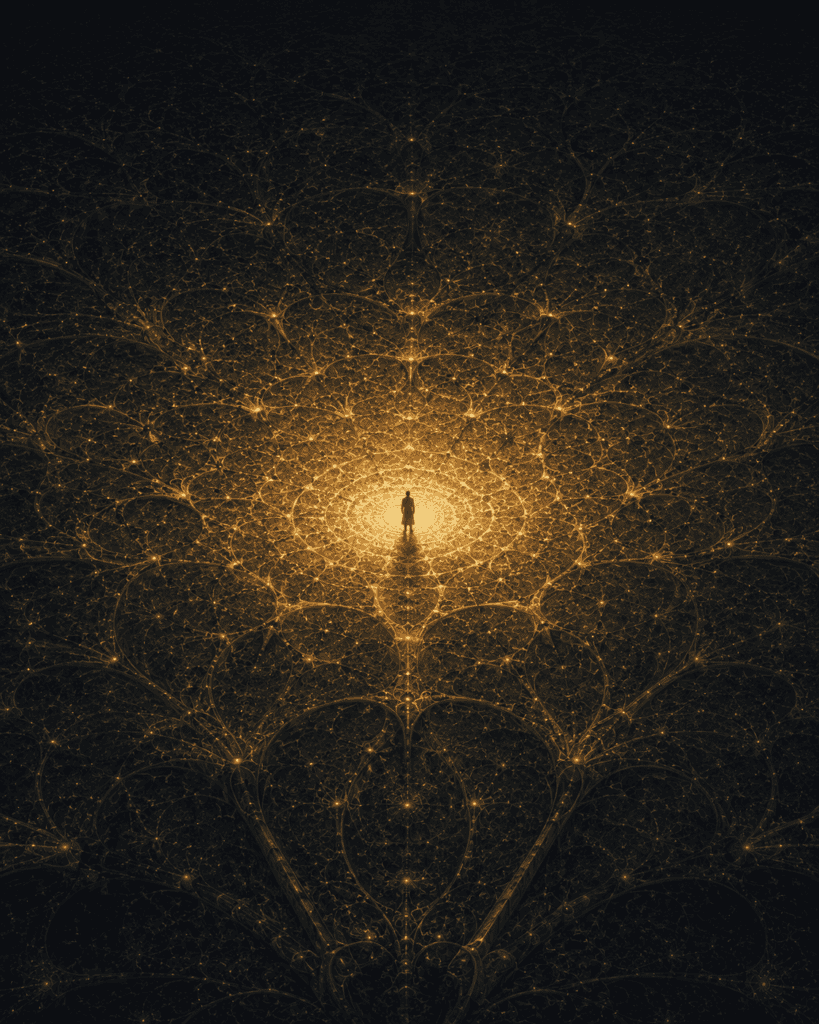
So when your own turn in the dark comes, and it will, hold onto this. Whatever is dying right now, a plan that came apart, a version of you being stripped away, a stretch gone cold and quiet, you are standing in the going-down, and the going-down is the only part you can see from inside it. But it is the same shape you have watched at every other scale in this whole story: what goes down in God comes up greater than it went. Trust it where you stand. That does not make the dying hurt less. It means the dying does not get the last word.
It works the same way with God himself. You climb to what looked from below like the top, and a whole range opens that you could not see before. The horizon did not run from you; you climbed high enough to see past where you stood. You know him in part at the start and in part at every step after, and the gap never closes. It deepens. Each level you actually reach turns from a thing you hoped for into a floor you stand on, and from that floor a further horizon comes into view. Faith becomes sight. Sight becomes the new ground for faith.
From faith to faith. From glory to glory. You see in part, you always will, and the pattern is the reason you can walk forward into the dark anyway.
The Triangle Points
The Father is greater than everything we built to reach him. Not the line or the circle, not the three, not even the cross holds him. The triangle doesn’t contain him; it points toward him.
That is not just a polite disclaimer. It is in the shape itself. A triangle is built like an arrow. The point lifts off the base, up out of the flat, away from itself. It does not curl back closed the way a circle does. It rises, as the word rose from the union of mouth and tongue. Whatever you draw a triangle around, the shape is already aiming past it. It refuses to be mistaken for the thing it stands for.
The whole argument works the same way. The tree points to the pattern. The pattern points to the rule that makes it. The rule points to the Logos. The Logos points to the Father. Every step, followed honestly, opens onto a step above it, higher and higher until it climbs out of sight. The pattern you can see is pointing at what you cannot. None of it is the end of the road. All of it is an arrow.
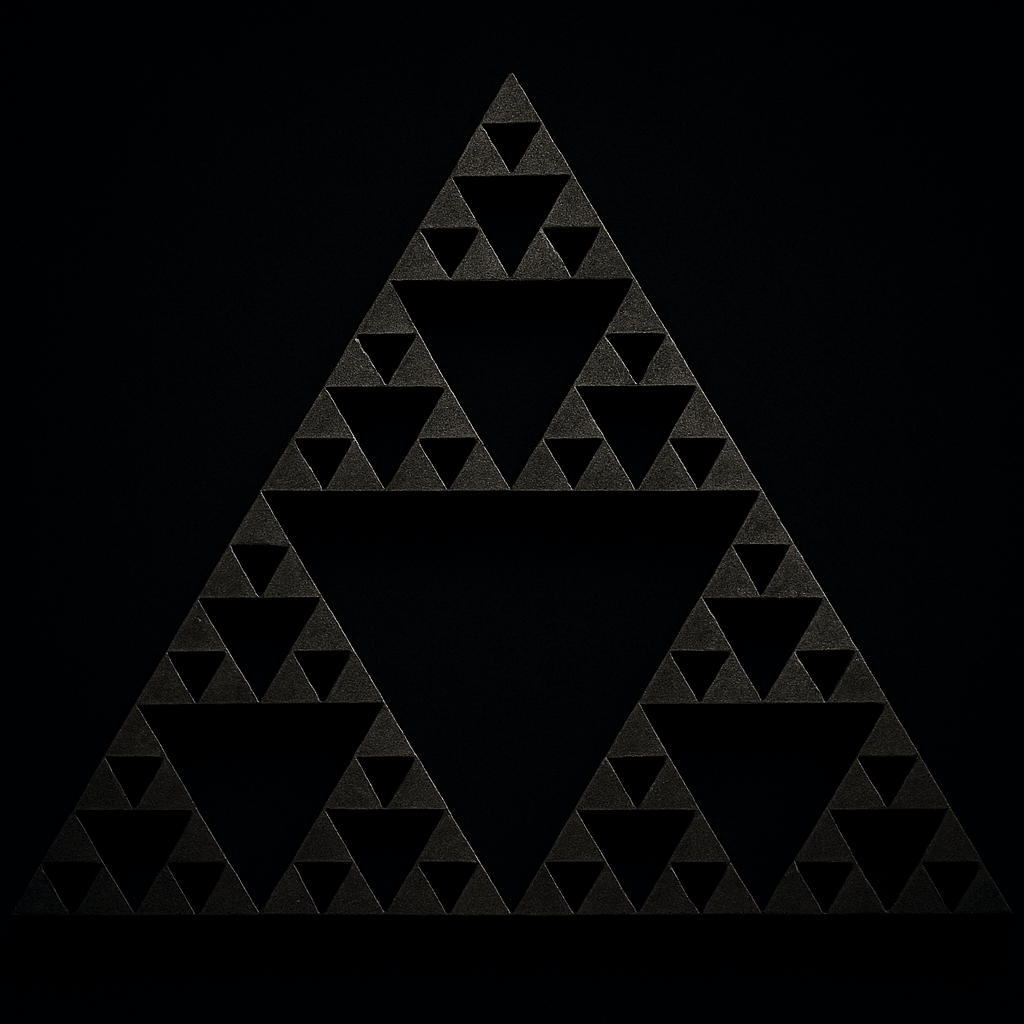
That is not the argument failing. It is exactly what you would expect if the source is real and bigger than us. A God you could fit inside a tidy system would not be God. He would be one more thing inside the system. So the argument carries you as far as an argument can go, and then it hands you over. That handoff is not the argument breaking. It is the argument finishing its job.
This is John the Baptist all over again. He was not a pointer who became useless once Jesus came. He was a pointer whose whole purpose was complete the moment the One he pointed at arrived. Every real discovery works like that. The thing that changed your life and then showed you its edges was never wrong. It was doing exactly what the best things do: carrying you as far as it could, and then handing you to something it could never carry you to itself.
Which is why this was never a proof, and was never going to be. A proof closes the case; this opens onto something past it. It’s the best explanation I’ve found for why the same shape keeps turning up in places that have nothing to do with each other, and you’re free to look for a better one. What I keep finding is that the Logos will not stay out. Try to explain the pattern without him, and he walks back in under another name, because holding all things together is one of his fingerprints.
So here is the shape of the whole thing. The world is a self-portrait of its maker, drawn in the same pattern over and over, signed by the one who calls himself I am that I am. Every scale of it carries the same signature: the structure of space, the workings of a healthy mind, the long arc of history.
The Logos through whom all things were made left his mark in everything he made. “In him all things hold together.”
The pattern doesn’t explain Christ — the pattern is explained by Christ.
Leave a Reply