
In Part I you are a reflection, a conscious mind held inside a larger Mind, the way a man named Frank would be held inside your imagination, you holding him in being. Frank reasons that the source behind the world’s pattern must be a face: personal, relational, a giving and a receiving older than creation itself. But he also proves he can never reach it from inside: a character cannot turn around and find his author. The face, if it is known at all, must lean in.
The Wound in the Dream
♪ (read with: Arvo Pärt, “Cantus in Memoriam Benjamin Britten”)
But suppose the face is real, personal, and, as Frank’s reasoning kept insisting, loving. Then we have not escaped the hardest question in the world. You, in the dreamer’s chair, hold Frank’s entire world in being from one instant to the next, which means you are also holding in being the earthquakes killing thousands of people, and the hand that tortures an animal for the pleasure of it. If nothing in Frank’s world exists unless you think it, then the cruelty exists because, in some sense, you are thinking it too. A loving dreamer sustaining a nightmare. The daydream does not soften the oldest charge against any good God; it makes it worse, because now there is nowhere for the darkness to come from except the one mind holding everything up.
The Trinitarian tradition says something strange: evil is not a thing. It has no being of its own, no ingredient the dreamer adds. Blindness is not a substance; it is the absence of sight, just as darkness is merely the absence of light. Rust is not poured into iron; it is iron failing to hold its form. A tumour is not a designed object; it is a cell’s good machinery turned against the body it was made to serve. Evil is always a good thing bent: a wound. And a wound is not something you dream up; it is the place where what was dreamed refuses to be what it was made to be. So you are not dreaming the horrors of Frank’s world. You are sustaining the man, his strength, his will, his freedom, every one of them good, every one held in being by you. The evil is the use he makes of them, and that turning is the one thing you did not author. You hold the being. The wound is where he lets go of it.
Even the devil is no exception. Satan was never created to be Satan; he was an angel, a good so high that its own shine turned to pride, refusing the humility it owed its source. Nothing is ever made evil, only unmade: a good closing its eyes to what it was for, and coming apart as it turns away. There is no original darkness waiting at the bottom, no eternal war of good against evil. There is only the wound: a good, turned away.
But then why give such dangerous gifts at all? Why a creature free enough to tear holes? A dreamer could fill a room with figures who never disobey and wound nothing, and they could never love. Love that is not free is not love; it is mechanism wearing love’s face. To make a creature that can freely turn toward you is to make one that can freely turn away. The capacity for the wound and the capacity for love are the same capacity. A world that could not produce the cancer ward could not produce the embrace.
That is true, and it is not enough. It makes the wound make sense. It does not make it hurt any less. Anyone who has stood in the children’s cancer ward knows the difference. And some of it answers to no freedom at all: no one chose the earthquake. But the world made solid enough to hold a real embrace is the same world whose ground can shift and whose cells can turn, and you cannot have the one without the possibility of the other. The tradition says more: that this world is not yet in its final form, a good creation still unfinished, groaning, as Paul said, toward a repair in which what lets us love will remain and what wounds will not. What none of this answers is the last and smallest question, the only one that finally matters in the ward: not why suffering is possible, but why this one, why now. There the reasoning runs out, and the tradition admits the limit. The wound was not only permitted but foreseen. The one who holds the world in being did so knowing every use its freedom would be put to, and sustained it still; why that cost was judged worth paying is the one thing no one inside the world can see.
Frank is a character inside one scene, and he cannot read the book he is in. The figure suffering in chapter three cannot see chapter thirty, cannot weigh whether this darkness is a thread in a redemption invisible from where he stands. From the dreamer’s chair you can see the arc; from inside the room Frank cannot. “My thoughts are not your thoughts,” the author says, not because he is unknowable, but because knowing someone is good is not the same as reading his mind, any more than trusting your closest friend means predicting his every decision. Frank knows the kind of author he has. He cannot, from his chair, read the plot. This is the one place “lean not on your own understanding” is not a dodge but the only sane posture left. You earn it at the end of the honest work, never as a shortcut past it. Frank is not trusting blindly; he is trusting a particular author, whose character his own reasoning walked him toward, and whose face, as we are about to see, did not stay in the chair.
Because that is the last thing, and it is what makes this unlike any theory of evil ever written. The Author’s final answer to the wound was never an explanation. It was not a sentence. It was a step.
The Door Opens From the Other Side
Go back to Frank one last time. He stands in the room you built, surrounded by your patterns, unable to reach you by any effort of his own. He can study the walls forever, meditate down into the foundations and find your fingerprints on every particle. He will never find your face, because the face is not inside the frame.
When Moses asked to see God’s glory, the answer was: “You cannot see my face, for no one may see me and live” (Exodus 33:20). For most of history that reads like a prohibition, a padlocked door. It is not God denying entry. It is the same structural fact you are looking at from the dreamer’s chair: the face is not an item in the world, and a character cannot turn around and find the author inside the story. “And live” is just as exact: to see the face fully would be to step outside the frame, and for a creature inside creation that is death. So what God let Moses see was his back, his trace, the wake of his passing: the footprints, not the face. Moses saw the footprints and knew them for what they were. Spinoza, later, saw the same footprints and called them the foot.
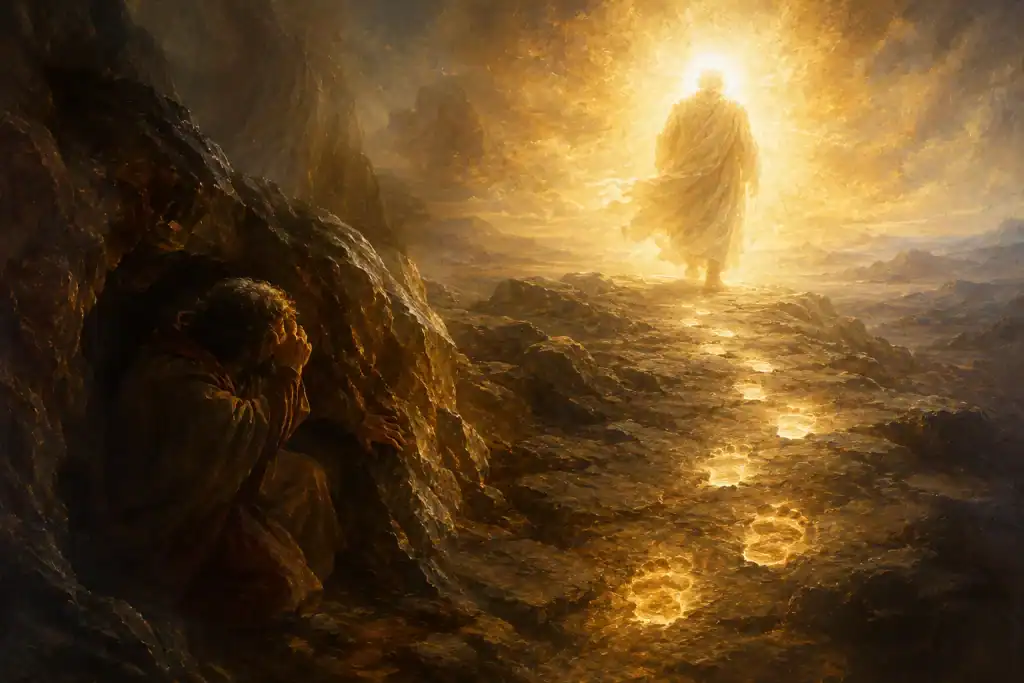
Unless you step in, write yourself into the story: take on the conditions of the world you made, inhabit it from the inside, become a character in it while remaining the mind that holds the whole thing together. Then, and only then, do the people inside have any chance of seeing who has been dreaming them. This is what revelation means: not information shouted from a distance, but the author entering the narrative.
Here the daydream reaches the edge of what it can do, and it is worth being honest about where that edge is. It has shown you the outline: that the face cannot be found from inside, that if it is ever to be known the Author must come in, take flesh, become findable. What it cannot tell you is which of history’s voices (there are several, each certain) is the Author actually arrived, and which only claimed as much. That is a different question, answered by history and prophecy, and it is not the work of this piece. So take what follows not as something the daydream proved, but as the one claim that fits the outline it drew. It is a figure who says he is exactly this: the mind that holds the world, stepped into the world, in a particular body, with a particular face, who stakes it all on clues left centuries in advance. Here the daydream’s gift is smaller and stranger: it tells you what to look for. The true door, if there is one, will be the Author become a person you could meet.
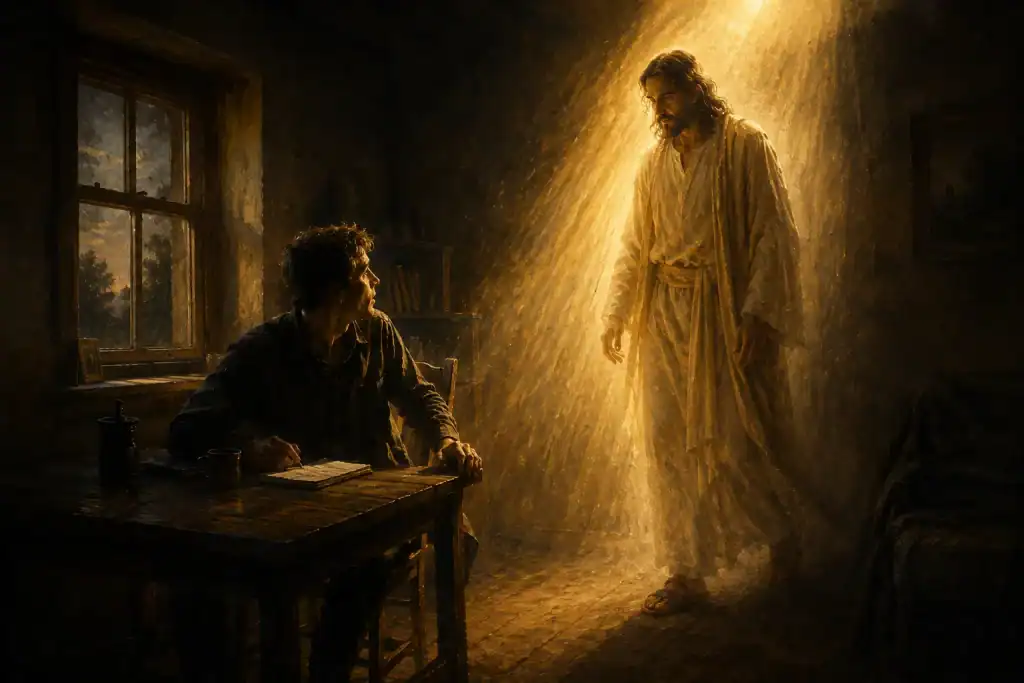
And the most radical version of it, the one that breaks every closed loop, is the incarnation: the mind that sustains all things taking on a specific face, a specific name, a specific body. Born in a town named centuries in advance. Dying by a method described a thousand years before it was invented. Rising with the same body, the wounds kept, the face known to those who had eaten with him. This is how the face no one could see and live became a face you could look at and live, not by becoming less than God, but by veiling the full blaze in flesh, the unapproachable light turned down to the brightness of a human face, the very face Moses was shielded from, now leaning across a table toward you. “No one has ever seen God,” John writes; “the only Son has made him known.” And to the disciple who said show us the Father: “Whoever has seen me has seen the Father.” The footprints, at last, belonged to a face that had turned around.
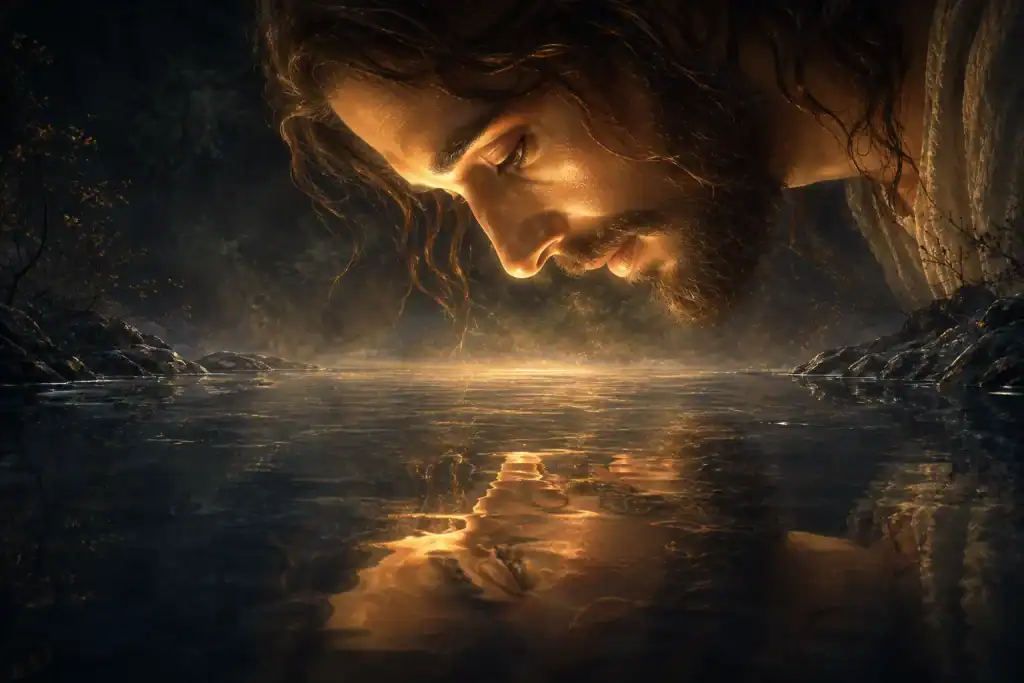
Frank could never reach your face by going deeper into the daydream. But if you stepped in, stood in the light you made and let him see you, everything changes. The pattern now has a person behind it. The structure now has a name. The reflection in the water looks up and, for the first time, sees the face casting it.
And the face says: I am.
He Had Come Before
♪ (read with: John Tavener, “The Protecting Veil”)
“I am.” It is the name he gave the first time he leaned into the world this way, a voice out of a bush that burned and was not consumed, telling a barefoot shepherd the ground had gone holy. And not the only time. All through the long story before Bethlehem, the dreamer had been putting a hand through the seam: appearing, veiled, just far enough to be seen, then drawing back before the brightness could burn.
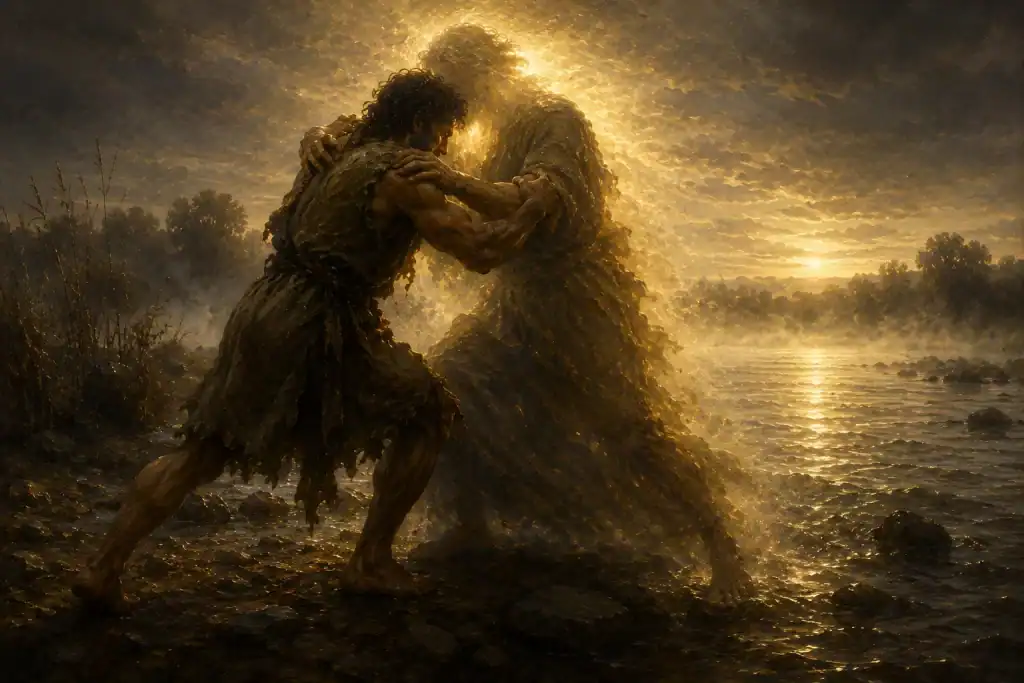
A man wrestles a stranger in the dark by a river and limps away at dawn saying, I have seen God face to face, and lived, astonished he survived it. Three travellers come to an old man’s tent in the heat of the day, and one of them is the Lord, and they eat together under the tree. A childless couple meet a messenger whose name is too wonderful to give, and he rises to heaven in the flame of their altar, and they fall on their faces certain they will die for having seen him, and they do not. Seventy elders climb a mountain and see the God of Israel on a pavement of sapphire, and he does not lift a hand against them, and they eat and drink in his presence. A man in the temple sees the Lord high on a throne, the hem of his robe filling the room, and cries that he is undone, a dead man, for his eyes have seen the King, and a burning coal touches his mouth instead, and he lives.
Every one of them braces for death, because every one knows the rule: no one sees God and lives. And every one lives. They think they have looked on the full blaze of God himself, and by their own logic should be dead. What they could not have known, because the word for him had not yet been given, is that the rule was never about the one they had actually met. No one has ever seen the Father; but the one the wrestler wrestled, the guest at the table, the King on the throne, was the Son, the seeable God, the face God turns toward the world. The death that falls on anyone who looks at the unveiled Father was never coming for the men who met the Son. They braced for a blow from a meeting they had not had. The rule was never broken; they had simply met the one Person in God it does not touch, and had no name for him yet.
So the incarnation is not the first time the dreamer stepped into the room. It is the time he came in and did not leave. Every earlier appearance was a hand through the seam, withdrawn before the warmth could settle. Bethlehem is the seam torn fully open: the dreamer stepping all the way in and staying, taking a body he would not put down again, a face that would not dim and be gone by morning. The previews had always ended. This one doesn’t. He came in, and he is still here.
Now Climb Back Down
You have been sitting in the dreamer’s chair this whole time, watching Frank reason and missing nothing, because from up there the answers were obvious. You could see what Frank could not. His self-sufficient world was held in being every second. Searching the furniture for its maker was hopeless. Only one thing could ever close the gap: the dreamer choosing to step in.
Now look at the room you are actually in. It feels solid. Self-contained. The only world there is. And most days it never occurs to you to ask whose imagination it is shining in. You are Frank. You always were. And everything obvious from the dreamer’s chair is true of you, exactly: you will not find the face by looking, the world is held in being by the Dreamer you cannot detect, and the gap can only be closed from the other side.
The Christian claim is that it has been. The Dreamer stepped in: not in disguise, not wearing the world like a costume he would shrug off, but as one of the people in the room, real flesh, findable, woundable, and he let himself be seen. Not so we could finally prove him (Frank could never prove you, the dreamer) but so we would no longer have to.
And what you have seen even now is only the face turned down to a brightness you can survive. The full light is still ahead. “Now we see through a glass darkly,” Paul wrote, “but then, face to face.” Frank is not there yet, and neither are you. But the dark glass is no longer empty. Someone is on the other side of it, and he has already come through once to find you.
And do not mistake what that crossing is, or which way it runs. The Author did not lift a character up and out of the story to save him. He did the opposite. He stepped into the story, went through death from the inside, and came out still himself, with his body, alive. He did not escape the page. He redeemed it. So your death is not the story ending, and it is not you being pulled off the page into some bodiless elsewhere. It is the page itself made fully real at last: the light that was always outside it flooding in, the Author who once only visited now here to stay, and you raised, embodied. Still yourself. Not dissolved back into him like a drop into the sea, but more yourself than you have ever been. Not a waking out of the world, but the world finally awake, and you awake in it.
You are not brought near the face to admire it from the doorway. You are drawn inside the very life it is. Remember what Frank found the source to be: not a lonely One but a giving and a receiving, a love that was already a relationship before the world began. To be saved is not to be allowed to watch that exchange from outside it. It is to be taken into it: to be loved with the same love the Father pours into the Son, held inside the current that made everything, a real other now caught up in the endless giving and receiving and never once stopping being yourself. “That they may be one,” he prayed, “as we are one; I in them, and you in me.” Not absorbed into God. Taken into the love that God is. The reflection is not left to study the face across the water. It is drawn up into the life the face was always living.
The reflection does not explain the face. The face explains the reflection. And the only reason the reflection knows the face at all is that the face leaned out over the water. And looked back.
Leave a Reply