
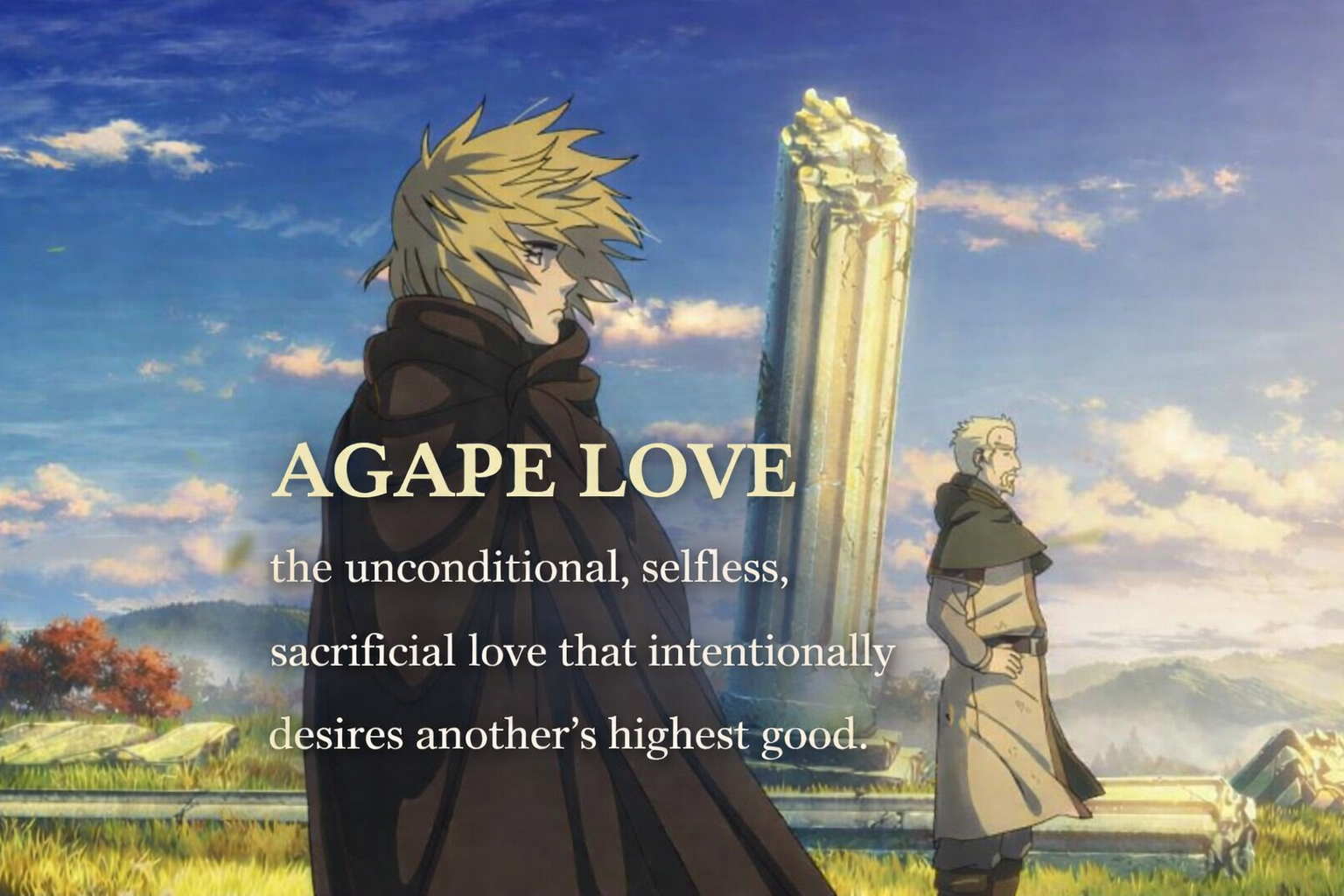
Media can be such a wonderful vehicle for change, especially when it’s used in a way that makes viewers think about the very things that define their lives. That is certainly the case in the above clip from Vinland Saga, where the young Prince Canute wakes up after a dream on a battlefield, remembering his precious caretaker, Ragnar, as someone who truly loved him. Taking that even further, Prince Canute would even say that Ragnar didn’t just love him, but that his love was true love, and there was no greater love than this.
It is then that the priest–sitting, drinking and observing the revelation that Canute is having–chimes in. He says something profound, something that knocks the revelation that Canute has had right out of his mind–that what Ragnar performed for Canute was not love, but instead, “His tender feelings for you were discrimination.” All of the time, effort, and energy that Ragnar had spent helping, raising, and nurturing Canute was nothing more than picking and choosing, something done out of favoritism, out of a survival instinct, out of selfishness.
When Canute asks the priest what love really is, the priest then turns and points out the body of a dead man laying out in the open on the cold snow of the battlefield.
“He’s right there. See? When he died, he became more beautiful than anyone among the living. He’s love itself. He’ll never hate others or steal again. […] He’s going to give his body with generosity to the beasts and the insects. He […] won’t speak a single word in complaint. Death… perfects a person.”
In Christianity, there is a phrase known as agape love, which is considered the highest form of love, a love that is entirely selfless, entirely self-giving. Considering the fact that Vinland Saga borrows heavily from Christianity and even features a Bible reading scene at one point, it is quite easy to see where the inspiration is being drawn from here.
The priest is pointing at something very specific. When a person is alive, they discriminate in terms of how they apply their love. When a person’s body is dead, no more discrimination takes place–they give fully to the world, the world taking from them whatever it needs in whatever form it appears, whether it’s animals converting the body into caloric energy and nutrients or bones being turned into fertilization for the soil. So, truly, a deceased body does not discriminate–in fact, discrimination isn’t even something that is a part of its potential faculties.
The idea of a non-discriminatory love certainly sounds quite beautiful. And the priest is totally correct–God, being Love, is truly and totally self-giving, the most pure form of love that there is, and this is mirrored in all of creation. But is this what is meant by “agape love”? Is this what Christ Jesus meant when he said “Love thy neighbor as thyself”? Surely, the priest–engrossed with the miniature keg he was drinking out of–was on the verge of something profound. But is there something that was missing? Or does the pursuit of spiritual love truly result in letting the world take from you what it wants without thought?
How Love without Attachment Meets Discernment
Was the love that Ragnar showered upon Prince Canute not actually love because it was discriminatory? Should Ragnar have shown every individual he came across the same amount of attention as he showed Canute? Certainly, that wouldn’t make sense. Ragnar was assigned a duty, and then set out to fulfill that duty the best he could, showing the kind of affection he knew to show Canute. The priest points to nature as a signifier of what love really means, of what non-discriminatory love actually is. But is that the case? Let’s examine.
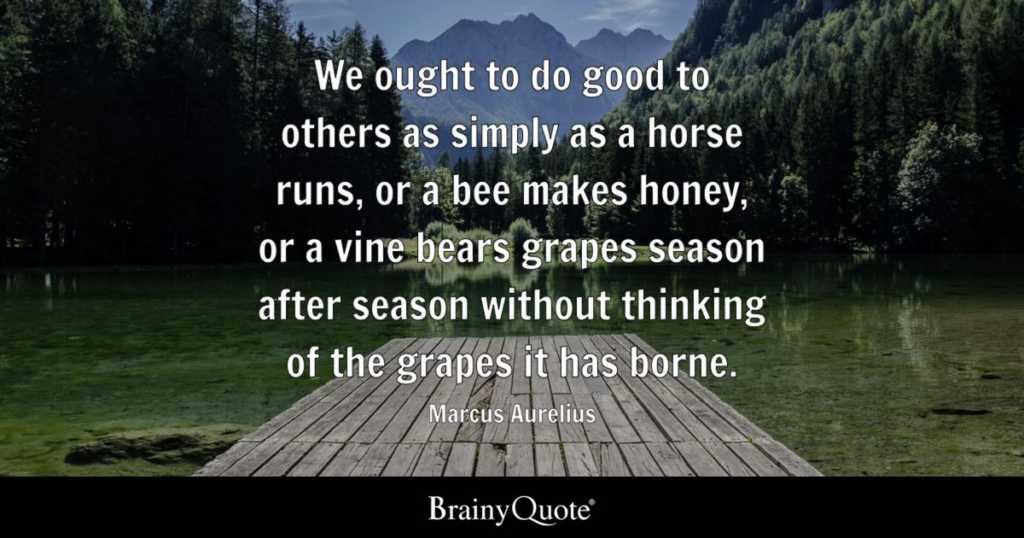
Temporarily borrowing from the intuitive stoics, Marcus Aurelius once said, “We ought to do good to others as simply as horse runs, or a bee makes honey, or a vine bears grapes season after season without thinking of the grapes it has borne.” What both Marcus Aurelius and the priest in Vinland Saga are pointing at here are actually not too far apart: To act in goodwill towards others without expecting a single thing in return. And truly, as the grapevine slowly unfurls, drawing water and nutrients from the soil around it and using energy from the golden light of the sun to forge sugar for its fruit, it never once thinks, “I really want the seeds in these grapes to be planted so I may have a great number of offspring!”
So we see, the grapevine is acting truly with non-attachment, doing its duty with complete devotion to the Lord without a moment of hesitation. It is truly a magnificent creation! It never doubts, hesitates, gets distracted, falls into temptation, wrath, envy, lust–it has been perfected. Yet does it act with discrimination? Of course it does! The grapevine does its duty all in a single direction: To grow grapes so that its seeds may be spread. And though it does look to spread its seed, it does not worry for one second that this event won’t happen. It simply does its duty, produces grapes, humans and animals eat those grapes–and what happens next it has no concern for!
So when Ragnar does his duty to provide love and nurturement for the young Prince Canute, is this a failure in love? Or is this the dutiful, rational fulfillment–in whatever degree–of the human’s directive to be diligent in our duties here on Earth in an act of devotion? After all, are not humans also a part of God’s creation, and thusly also presented with a direction for growth and development, a way to bear fruit no different than the grapevine?
Of course, humans and grapevines differ quite substantially. To begin with, the human must barter with his rational faculties in order to move and operate–much more complex than the simple fulfillment of DNA, as is the case with the grapevine. And yet, as is the ultimate aim for the grapevine to bare seeded fruit so it may continue its creation, year after year, without any attachment to the result–so too shall a human have an aim that is both non-attached as well as fully discriminatory in nature, only this time with the use of a rational faculty rather than strands of DNA.
So then, we understand that every human has some kind of duty that they are to carry out that was decided upon through reason. For Ragnar, his duty was to take care of the young Prince Canute. He likely had other mundane duties, such as taking care of himself, eating, washing, sleeping, perhaps some forms of manual labor, and so on. These things are a given. What, then, determines that these duties are meant to be fulfilled in a way that is entirely self-less, entirely self-giving, without a strand of attachment to the outcome yet with full intention the entire way?
The priest points at the dead body as the highest form of love. Yet a human being is not a dead body. So then how are we to experience the highest form of love as living human beings? By being in alignment with the nature of God entirely while still breathing, not by ending the gift of our rational faculties that differentiate us from a carcass, but instead by using them as a tool instead of worshipping them as God itself. And how is the rational mind bent to be in alignment with God? By being fully in alignment with the rationally derived identifications of whatever is good, virtuous, and admirable for all. This way, while a person is still breathing, they may be just like that grapevine as well as that dead body, serving their purpose fully and intentionally, giving fully to the world around it, without expecting a single thing in return. (Not that there are no returns–just that the fulfillment of duty doesn’t depend on it!) The priest points at the dead body as a paragon of virtue, seeing how it is fully giving in its decomposition, how it sacrifices itself for those around it–not realizing that Christ Jesus himself demonstrated how we may be fully giving and fully loving, and invited us to do the same!
Ultimately, it’s most vital to see that discernment of truth and duty are not discrimination. Discrimination would be to apply a virtue to one person but not the other–that is not Love, which “shines on both the righteous as well as the wicked”. But Love, which includes what is logical, has no problem with discerning and deciding on dutiful intent. So treat all with Love, treat all as a friend, with self-giving kindness and support–but as the animal goes about its foraging, as the plant grows, so too shall we go about our duties as humans. This lack of understanding on the part of the priest, and the misunderstanding that he passed on to Prince Canute, is perhaps what would later lead to the destructive and violent path that Prince Canute goes on.
How We Can Apply this Teaching Today
When I started this blog, the number one thing I wanted to focus on was what Christ Jesus himself invited us to do–to change.
Mark 1:15–”The time is fulfilled, and the kingdom of God has come near; repent (Gk. μετάνοια, metánoia) and believe in the good news.”
Metanoia. (Gk. μετάνοια, metánoia) — noun (fem.)
a change of mind/heart; repentance—a decisive reorientation of one’s thinking and life toward what is True (and good, and holy, wholesome), going beyond one’s present way of thinking to align with reality as it is. — etymology: from meta- “after, beyond; change” + nous “mind.”
The point of this blog is not fanciful philosophy and ideas. It is wonderful to dive into cool ideas from TV, movies, books, and popular culture. But at the end of the day, spirituality is not a philosophy. We are being invited to change and experience the kingdom of heaven for ourselves. To turn our hearts towards the highest good, towards whatever is noble and right and virtuous, towards the end of suffering and happiness for everyone.
So as we contemplate these ideas of what it really means to live a life of love, let us remember to bring every thought into captivity, to bend our mind towards Christ. Seeing clearly, abandon thoughts of selfishness, envy, wrath, gluttony, and so on, all derived from a sense of scarcity, and enter the kingdom of heaven here and now by replacing them with thoughts of wholeness and holiness. Aim for what gives life, not what gives death. Use all the discernment of your rational faculties in order to pursue this as earnestly as possible.
Romans 12:2–“Be transformed by the renewing of your mind, that ye may prove what is that good, and acceptable, and perfect, will of God.”
Most importantly, remember that we are not meant to wait until death to experience Love first-hand. The priest in Vinland Saga offered us some profound ideas, but ultimately lacked in completeness, not seeing that lived duty and alignment with Goodness itself can be experienced here on Earth as was exemplified through Christ Jesus. This is accomplished not through the death of the body, but through the death of our fleshly desires, our selfishness, the things that we place above proper and noble ordered virtue. C.S. Lewis once said, “Every Christian is to become a little Christ.” Therefore, let each of us press onward toward conformity to Love, with proper discernment, setting selfishness aside so that we may more fully become “little Christs.”

Leave a Reply