
The Dream You Cannot Wake From
♪ (read with: Arvo Pärt — Spiegel im Spiegel)
You have had the dream where you know you are dreaming. Something tips you off: an elevator without walls, a face that shifts when you look too long, gravity doing something it shouldn’t. And for a moment, inside the dream, you know: this is not real, there is something outside of this. But you can’t get there. You can know you are inside something bigger than you, and still have no window, no vantage from which to see what is unnerving you.
Now keep that feeling and bring it forward.
You are conscious. You know you are conscious. You are, right now, having the experience of reading these words, and that experience is not the words on the screen; it’s something behind your eyes, isn’t it? If you try to turn around and look at it, the thing that is doing the looking, you cannot. You are inside it. It is closer to you than your own name, far closer. And you have no way to step outside it and see what it is, or where it comes from, or why it is happening at all.

This is not a poetic problem. It is the oldest open question in philosophy, and no one has answered it. What a question it is to be handed in the first place. What or who is the question-giver? No wonder we can only speculate.
The Room With No Exits
Neuroscience can map the brain with extraordinary precision: which regions light up when you feel joy, recognise a face, tell a lie. It can correlate every subjective experience with a measurable event in the nervous system. What it cannot do is explain why the measurable event feels like anything at all.
This is the hard problem of consciousness, and the name is damn honest. It is hard not because we lack data but because the data points where the method cannot follow. You can describe every molecule of water in a wave and still not explain why wetness feels wet. The objective account does not produce the subjective experience. Something is missing from the description: the very thing you yourself experience.
Some say we just need more time; science is obviously moving forward all the time. But this is not a gap between what we know and what we don’t. It is between two kinds of knowing: the view from outside (measurement, mechanism, cause and effect) and the view from inside (what it is like to be you, right now, in this room with no exits). A way of knowing built for one category has no standing to make claims in the other.
The lights are on. No one knows how to turn them on. They were on when you arrived.
The Pattern on the Walls
But you can look around. And if you look carefully, the room has a structure.
The same pattern shows up at every scale. A river branches like a lung branches, like lightning branches, like a thought branches into associations. Zoom in and the pattern holds; zoom out and it holds. One thing that is irreducibly more than one: differentiated unity, repeating from the subatomic to the cosmic.
This is what a fractal is. Not repetition. Self-similarity. The same shape at every magnification, whether you look through a microscope, a telescope, or a mirror.
If you have read The Fractal Nature of Reality, you perhaps understand where I’m coming from. The pattern is real and everywhere. The question that follows: is the pattern all there is, or is there someone behind it?
A wallpaper pattern does not require a mind. But it does not produce minds either. And you, the one looking at the walls, are a mind. You are not just seeing the pattern; you are seeing it as something, aware of it. The room contains the one thing a mere pattern cannot account for: a person who asks what the pattern means.
The Reflection in the Water
Carry the pattern one step further. If the same structure runs through everything, your own mind is not an exception to it but an instance of it. The fractal does not stop politely at the edge of your skull. The awareness you are reading with is the pattern at the scale of one person: a small, real echo of whatever stands at its source. Which turns the hard problem on its head: consciousness is not a freak accident, matter flickering awake for no reason, but exactly what you would expect if the source of everything is itself a mind and you are a finite instance of it. Not the source. Not self-made. The same kind of thing, at an incomparably smaller scale.
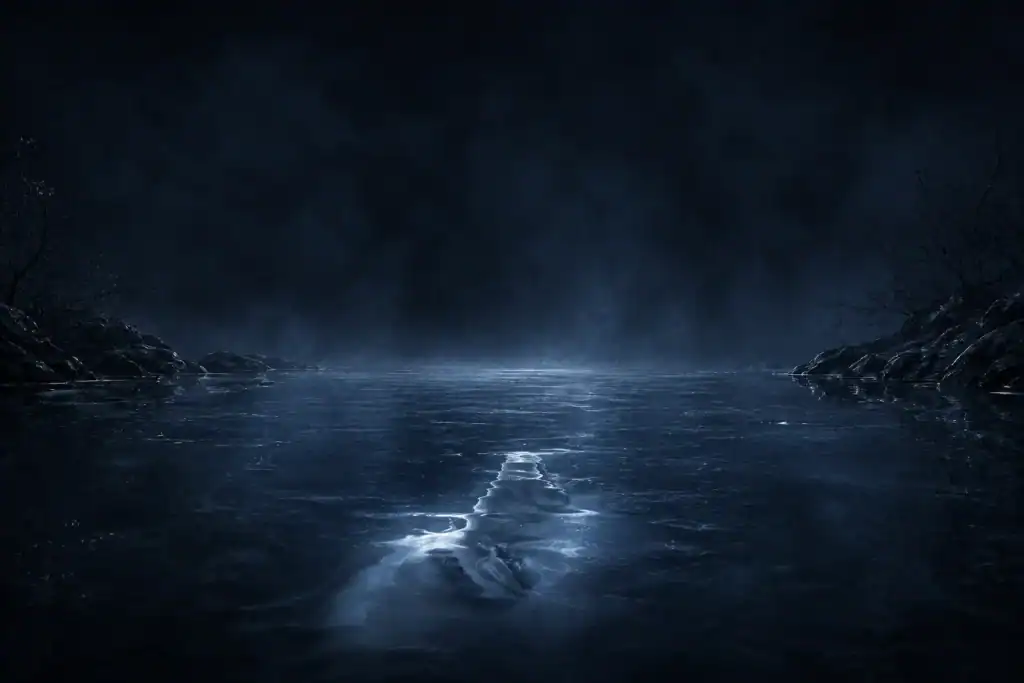
Picture a still pond. A face appears on the surface. Now imagine the reflection in the pond saying: there is no face, I am self-caused, I rose from the water on my own.
You would know instantly what was wrong: the very words it uses to make its case are the evidence of the face it denies. The more articulate the denial, the more obvious the source.
That is the situation of a conscious being who denies a conscious source. The capacity you use to make the denial (reason, self-awareness, the power to hold and weigh a thought) is itself a reflection. It did not arise from nothing, and no arrangement of matter has ever explained why the arrangement is lit from the inside. The reflection is real. But in a fractal universe, it is a smaller image of something larger. And that something is not the water.
Meet Frank
♪ (read with: Vaughan Williams, “The Lark Ascending”)
Now try it from the other side.
Close your eyes and build a world. Nothing fancy: a room, a window, late-afternoon light across the floor. Put a man in it, middle-aged, maybe a bit of weather on his face, the kind who looks out the window and sighs in silent appreciation at the sight of leaves blowing in the wind. Give him a cup of coffee going cold in his hand, and a name. Call him Frank.
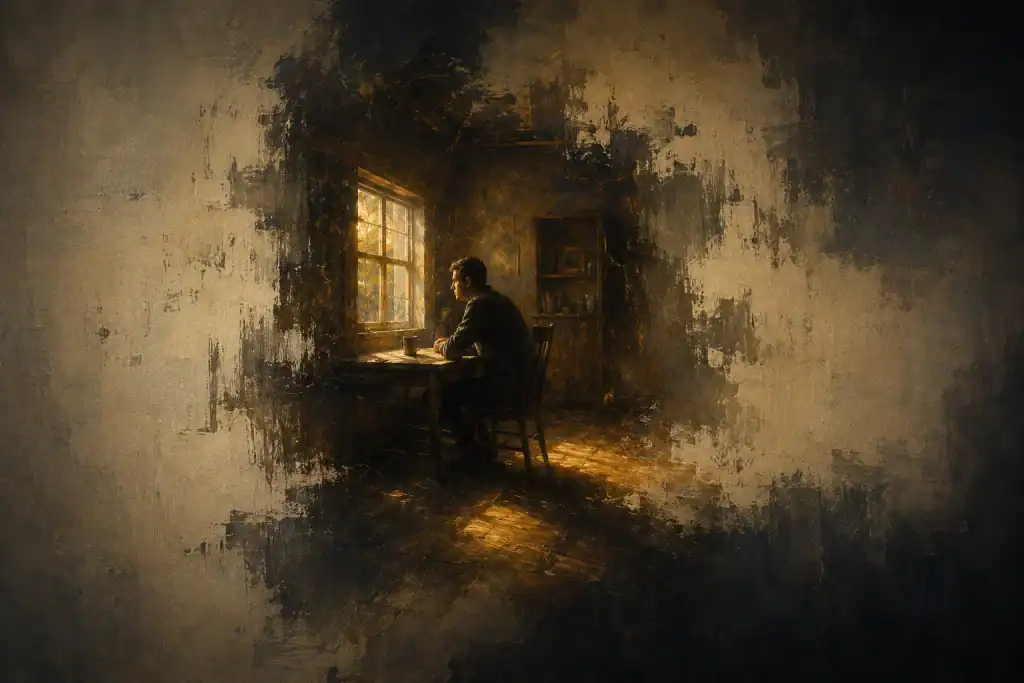
Frank exists now, not on paper but in your mind. He stands in light you are providing, in a room that emerges from you but to him just is, breathing air you created for him. The stubble on his jaw, the thoughts in his head, the warmth leaving the cup: all of it is there because you are holding it there. None of which makes him any less real. Held, he is completely real: a real man in a real room, not a wisp. Solid, particular, there. His reality is total. It is given to him, moment by moment. He holds none of it up himself. If you stop, he does not turn out to have been nothing all along. He ceases, the way anything real ceases when what holds it in being lets go of it.
You are, to Frank, God. Not merely as a figure of speech, but structurally. His reality is happening inside your mind. You made him, you hold him in being instant to instant, and you could stop generating him without effort or malice by turning your attention to lunch.
And the power you are using to do it, to hold a whole world inside a mind, is not one you invented or created for yourself, but one that runs through you from upstream, which is why Frank, if he ever reasons his way toward a source, will reason straight past you to whatever lies upstream.
And Frank has no idea. From the inside, his world is the only world. His room is solid, his lukewarm coffee real, the light through his window just the light. It never occurs to him to ask whose imagination it is shining in. His world feels self-contained, entirely his own, exactly the way yours does to you, right now.
But Frank is a thinker, the kind who cannot let a noticed thing alone. One afternoon he starts to wonder where it all came from, and cannot leave the question be. So he does what any honest mind does. He looks around, and he starts trying doors.
The first door: materialism.
The simplest, and not a foolish one: it is where most thinking people live. Maybe there is no one behind any of this. Maybe the room just is, a brute fact, uncaused, holding itself up. Frank searches for a seam, an edge, a maker’s mark, and finds none, which is exactly what he would expect if there is no maker. This position has a spine. You cannot refute him by announcing he is a character in a daydream: that is the very thing in question. No one has explained consciousness, true enough, but an unsolved problem is not a proof of God. Give the brain another century. At its best this is not a failure of wonder. It is a refusal to plug this gap with a word.
But look where Frank is standing when he says it. He is using the one thing his theory cannot account for, his own awareness, to rule out anything behind him. He is most certain of the single thing his theory was built to leave out: that the lights are on, that someone is home. This daydream cannot reach in and disprove him. Nothing can. What it exposes is the assumption he never checks and cannot check from inside: that his world holds itself up. (Here, at least, you know better. Stop attending to Frank for a second and his self-running world is gone, materialism and all. For it to run on its own, the fractal would have to break at exactly one point: him.) So he does not shut this door because he refuted it. He shuts it because it asks him to be most sure of the very thing it cannot explain, and he is too honest for that. Beneath the honesty is an unease he trusts: a true resting place should not feel this wrong.
The second door: pantheism.
Maybe the source simply is everything: the room, the light, the cooling coffee, Frank himself, all one substance wearing a thousand masks. But you know better, because you are the dreamer, and you are not your daydream. You were here before Frank and you will be here after. You are thinking about him; you are not made of Frank. The thought is real, but you are more real, and one is creator, the other creation. To say the dreamer is the dream is to lose the dreamer entirely: to mistake the footprint for the foot that pressed it.
The third door: panentheism.
Frank refines it. Perhaps we exist inside the dreamer, made of the dreamer: pieces of the divine mind, God experiencing itself as us. This is the closest door of all. Its one trouble is that it feels like arrival: so near the truth that you settle there and never take the last step, from being made of God to being with him. Frank is made of your mental activity, yes. But your mental activity is not you. The daydream is something you do, not something you are. Frank lives inside your consciousness without being a piece of your self. To mistake the thought for the thinker, even while granting the thinker is larger, is still to mistake the thought for the thinker’s essence.
The fourth door: deism.
Maybe there was a dreamer once, who built the room and walked away. But a daydream in this case would not be a clock. A clock, once wound, keeps its own time. A daydream keeps nothing: no mechanism, no momentum, no existence apart from being dreamed. The instant you stop, Frank does not carry on unattended. He ceases. So the plain fact that he is still standing there, still wondering, still holding that shitty coffee, means the dreaming has not paused for an instant. A maker can abandon a machine. A maker cannot abandon a thought and have the thought go on. If Frank still exists, the dreamer has not stopped dreaming.
The fifth door: monotheism.
Now Frank, feeling quite weirded out, follows the thread to a conclusion he cannot shake. A single mind behind everything: one, personal, distinct from the world, holding it in being moment to moment, with a will, perhaps even able to speak. This is the God the great monotheisms have reached toward, and on the essentials they are right. The dreamer has a face. The dreamer acts. He is neither the dream nor absent from it. Frank has reasoned almost all the way home.
Almost. What stops him is not a new argument but an old habit turned against him. Frank is a materialist by temperament: his instinct is to take things apart, to explain the whole by its pieces. But the harder he looks, the less the pieces explain. His own veins branch exactly like the lightning over the rooftops, like the river on the map, like the bare tree, like the bronchi in his chest: different materials, different forces, no shared mechanism, and still one shape, arriving again and again at every scale. He tries to reduce it and cannot. The pattern is not in the parts. It runs through them.
And once he has seen it he cannot stop, and it always has the same strange code: one thing that is somehow more than one. Three separate notes struck together become one chord, and not one of them is the harmony; it lives only in the distance between them. Two people give themselves to one another and a third appears: a child, neither of them, wholly a person of its own, who could not exist without the two. It is not a heap of parts, and not a featureless blur either, but a unity that needs its own differences in order to be a unity at all. And the deeper he goes, the more it holds: to exist fully is to exist as more than one, each thing held together by what passes between its differences. He searches, with the old rigor, for one thing anywhere that is pure, solitary oneness, and cannot find it. Everything that exists, exists in relationship.
But this needs a bit of thinking-through, because the sharpest objector could have an issue with this. Frank might say: the world is full of difference, so its source must be full of difference; a solitary One could only pour out featureless sameness. But that is not true, and the objector knows it. One laughably simple rule (square a number, add a constant, feed the result back in, over and over) generates the Mandelbrot set: infinite difference at every scale, from a source with nothing relational inside it. Difference alone forces nothing. Complexity is cheap. But look at what that rule actually makes: endless structure, self-similar at every scale, and not one conscious thing inside it. No person, no I looking out, not a single act of love. It is pattern with no one home. The rule reaches the structure and dies at the face.
And that is how Frank satisfies the objector, by following the pattern all the way up. The self-similar shape does not stop at rivers and lungs. Trace it to the top and you do not meet more structure; you meet someones who look back. The world is not merely differentiated; it is differentiated into persons: they look out, face each other, and love. A person who loves cannot be iterated out of an equation, because love is not a structure but a communion, someone giving themselves to a someone else. You can generate the pattern of a relationship; you cannot generate the someone standing inside it, the point of view, the self with enough reality to give itself away. The fractal has structure and no one home. You do not get the felt inside out of a mechanism that has none, and so the faces scattered through the world must come from a Face at the beginning. The real question was never how difference came from oneness. Difference is cheap. It is how love came to be here at all. A love that is real at the bottom of things needs, at the bottom, a genuine other to receive it. A solitary source has no one to love, and so is not love. Someone will answer that he could simply love what he makes. But then his love begins with the making: a God who needs a world in order to love is a God who needed the world, and a source that leans on its own creation to be itself is not the free beginning we were tracing back to. Eternal love needs a beloved who was always there, which the creation, arriving later, can never be. So the other has to be at the root: before the world, and not made of it. What Frank understands is that love cannot, by definition, be a lonely One. He is already, at the root, a giving and a receiving.
The sixth door: the Trinity.
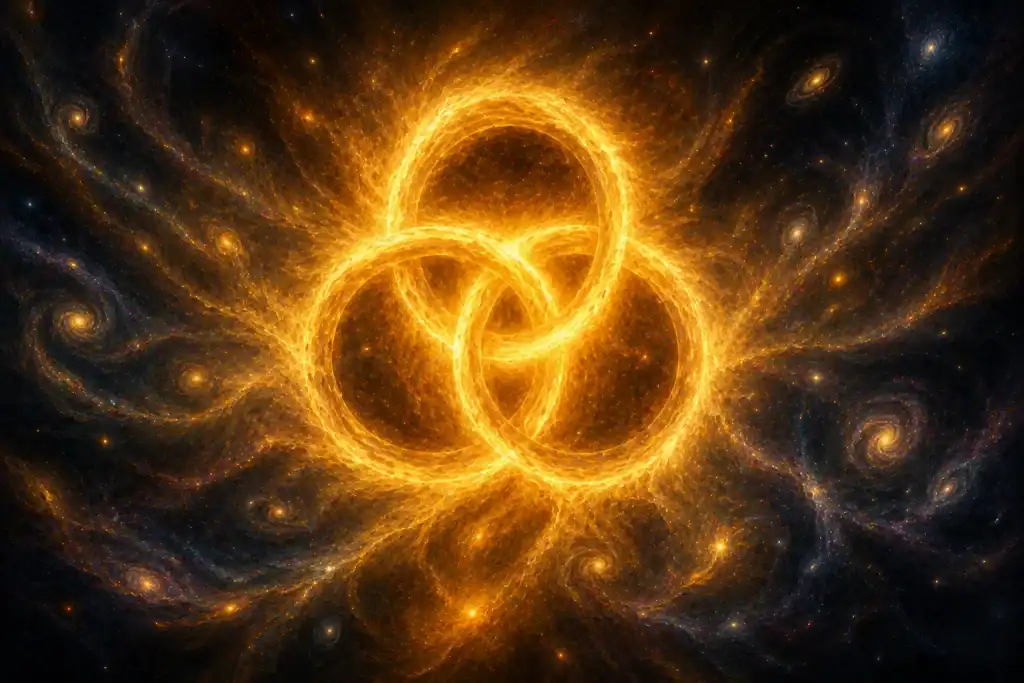
So he takes the last step his reasoning has been pushing him toward. The dreamer was never alone. Before the room, before the light, before Frank, there was already relationship: a differentiated unity, more-than-one held as one, a giving and a receiving and an overflowing. Father, Son, Spirit. And the world is what that overflow looks like when it spills past the edges of itself, the way a child comes from the love of two. This is the only answer that fits the world Frank actually lives in. It keeps the gap between dreamer and dreamed, yet holds them in a union that is real and intimate. It accounts for the relationship written into every scale. And it leaves the dreamer’s face free: real, and other, and able to turn toward him.
Turn it around one last time. You have been the dreamer this whole while, holding Frank in being, loving the small worn man you made. If the source is a giving and a receiving, then so is what moves in you toward him. You did not make Frank to be a puppet who recites your lines. You made him to be someone: a real other who might, one day, turn and know you.
In that hope there lives a deeply entwined ache. You see, a love that must command its return is not love. It is only coercion wearing love’s face. So you cannot reach into Frank’s world and turn his head toward you. You can hold him, sustain him, ache for him, and still you have to let him be free: free to reason his way, free to take his time, free even to decide there is no one there at all. You love him enough to let him be, and letting him be means you cannot make him come home.
So you hold him, and you hope, and you wait, and you go on loving him whether he turns or not. That is what it is to make a thing you love and set it free. The holding on is easy. The letting go, the loving without owning the end of the story, is love itself. It is the love at the bottom of the world. And it is the love that will do the one thing a dreamer has left when he will not force Frank’s door: he steps in, and opens it from the inside, and waits to be seen.
Frank has reasoned his way to what looks like the answer, but he knows any real conclusion must be stress-tested. Before he can stand in what he found, he has to get past the strongest objections the modern world can throw at it.
The Programmer in the Machine
Frank starts with the objection our own age finds most respectable. Maybe none of the old answers are needed, because reality is a simulation: information running on a vast computer built by some advanced civilisation. It is the favourite metaphysics of the engineer, because it feels like science rather than religion: no incense, no scripture, just processing power, and it simply scales up what we already do when we build a world in code.
But look at what the simulation actually claims. A world that does not exist on its own, sustained instant to instant by a system outside it. Laws chosen and written by a mind. That mind not inside the simulation, findable by no instrument within it. That is not an alternative to a creator. That is a creator, in a hoodie. The most secular person in the room, the one most certain he has left God behind, has quietly reinvented him as a programmer and called it physics. He has kept a maker outside the system, a sustaining act, authored laws, the live possibility of intervention, even perhaps the maker stepping inside. He balked only at the word. Strip the costume and the structure is the same. Someone is thinking the world.
The Faceless Answer
The simulation only hid its maker in a hoodie. Now a bolder objector steps forward: there is no maker standing apart from the world at all. That is the second door Frank tried, pantheism, and it had a champion worth presenting.
Baruch Spinoza, writing in the 1600s, argued that God and Nature are one substance. There is nothing outside God, because God is everything that exists; every rock, thought, and person is a mode of the one infinite substance. Elegant, consistent, and utterly faceless. Spinoza’s God has no will, no preferences, no personality, cannot love or be loved in return. The substance does not look at you; it has no eyes, and it does not know your name. And notice how “consciousness experiencing itself,” the phrase you hear everywhere now, is Spinoza in modern dress: the universe aware of itself, through you, as you. A closed loop with no outside, no one writing to anyone, no revelation possible.
Spinoza was not alone in this line of thinking. It is the place every tradition arrives at when it follows unity all the way down: Plotinus and the Neoplatonic One, the Brahman of the Vedanta, the non-dual schools that melt the self into a silent absolute. He gave the position its most exhaustive form, which is why answering him answers all of them at once.
He saw something real. The unity is real, the coherence at every scale is real; he earned the pattern. What he did not earn, what the pattern alone can never earn, is the face. A pattern does not speak, does not name itself, does not enter its own structure and say: I am. And his own principle turns on him. He insists on total unity, no exceptions. But he has to account for the fact that you think, that there is something it is like to be you. A rock does not wonder what it is; you do. If the pattern truly holds at every scale, then a mind at your scale means a mind at the source; a nature you are not separate from is a nature that thinks, and that is not an impersonal substance. It is a someone. His own unity hands him back the face he refused.
He mapped the walls. He missed the architect.
What the Water Feels Like
Frank ponders some more on this question, and thinks on something he has come across many times. There is a deep experience millions have had. Under psilocybin, DMT, ayahuasca, sometimes in deep meditation or at the edge of death, the boundary between self and world dissolves. The filter that says I am here and everything else is out there switches off, and what remains is a felt unity so total that people come back weeping, saying they were the universe experiencing itself, that separation was the illusion, that consciousness is all there is and they touched it directly. Often described as more real than waking life, not less. This is not delusion. Something genuinely happens.
Not everyone comes back with tears of oneness. Some are thrown into a void, or feel cut off from everything, or come back unable to put themselves together again for weeks. The same water, and it can drown as easily as hold you. And that is already a crack in the easy conclusion: if sinking into the substrate reliably handed you the truth that all is one and all is well, it would not so often hand you terror instead. Something real is happening down there. What it means is everything.
There is a hypothesis about what happens in the brain, and it is worth knowing, even though it is nowhere near settled. On the leading account, the default mode network goes quiet: the circuitry that keeps up your background sense of being a separate self, the running narration of “I.” With it quiet, the boundary it maintains loosens, and the felt line between you and everything else falls away. What remains is experienced as one undivided field. Whatever the mechanism, the experience itself is not in doubt. Something is felt, and it is felt as alive, and one, and older than the small self that feels separated from it. Whether that field of unity is the ultimate floor of reality, or a layer itself held up by something further still, is the question no one asks in the afterglow. For Frank it is the one that counts. Is the substrate all there is?
Suppose Frank could dissolve his own sense of being a separate self. What would he meet? Your mental activity: the raw medium that holds his world in being. He would feel the aliveness running under everything, and be right that it is alive, right that it is one from where he stands. But wrong to conclude the medium is all there is, because the thinker is still not the thought. He has felt the water the reflection floats on; he has not seen the face above it. And that is exactly what you are doing on the trip: the character reaching his dreamer and the human reaching the substrate, the same motion at two scales. Which means the experience is telling you something true: you are already inside a mind. You have not met its face.
That is the error: dissolving the reflection and concluding there is no face. But notice what happens: the experience ends. Frank comes back. If dissolution were the final truth, the return would be the lie; yet everyone treats the return as home and the trip as the visit. That is the signature of a window, not a destination. And the Christian mystics swam in the same ocean (John of the Cross’s dark night, the Cloud of Unknowing), the same ego-boundary dropping. But they do not conclude “I am God.” They conclude: the self was in the way, and now that it is quiet, I can hear the Other. Same experience. The reading splits it: I am God, or I can hear God. Identity, or company.
And see what the mystics were really pointing at. The self did not have to be annihilated for God to be heard. It only had to go quiet. The goal was never for the self to vanish; it was for the self to turn. What God wants is your company: to be with you, to love you and be known by you. And love needs a someone at both ends of it. Dissolution loses the very thing love requires, because it dissolves the beloved. What is offered instead is communion: not the drop lost in the sea, but two who become one and are still two, the self not erased but given, and received, and made more itself in the joining. God is not trying to lose you in himself. He is trying to be with you, because he loves you.
The psychedelic does not show you that you are the universe. It shows you what the universe feels like when you stop holding yourself separate from it. The water is alive, but the face above the water is the reason the water is alive, and no amount of dissolving into it will show you the face. For that, the face has to lean down.
The Honest Dead End
There is one last response, the most honest of all. Frank has reasoned his way to the answer, but reasoning to the dreamer is not the same as proving him. When Frank reaches to catch the face itself and be sure of it, his hand closes on nothing. So the truest-looking move is to say we cannot know. And there Frank is half right, more right than the ones who deny the face and the ones who claim to be the face. He cannot find the dreamer by looking. It is the same wall we hit at the start: no one can turn around and catch the one who is doing the looking. He can take his world apart atom by atom and never come upon the dreamer, because the dreamer is not an item in the world.
The mistake is only in the last step: from “I cannot prove the face” to “therefore the face cannot be known”. There is another way to know something you cannot seize: it can reach toward you. Frank cannot climb out of the story to find the author, but the author can lean into the story, and does: he holds Frank in being, and answers the ones who turn to him. What Frank cannot rule out is a greater move: that the face might step all the way into the world, openly, to be seen.
Part II asks whether it has, and examines the one claim that says it did.
Leave a Reply